Warning: Constant ABSPATH already defined in /home/raypasto/www/www/wordpress/wp-config.php on line 26
Warning: Cannot modify header information - headers already sent by (output started at /home/raypasto/www/www/wordpress/wp-config.php:26) in /home/raypasto/www/www/wordpress/wp-includes/feed-rss2.php on line 8 Research – Dr. Ray Pastore's Instructional Technology Blog
https://raypastore.com/wordpress
Wed, 14 Dec 2022 14:06:21 +0000en-US
hourly
1 https://wordpress.org/?v=5.7.20166124113Challenge: No Social Media for 24hrs!
https://raypastore.com/wordpress/2021/06/challenge-no-social-media-for-24hrs/
https://raypastore.com/wordpress/2021/06/challenge-no-social-media-for-24hrs/#respondSun, 13 Jun 2021 10:52:30 +0000https://raypastore.com/wordpress/?p=3618
]]>https://raypastore.com/wordpress/2021/06/challenge-no-social-media-for-24hrs/feed/036183D Learning
https://raypastore.com/wordpress/2019/03/3d-learning/
https://raypastore.com/wordpress/2019/03/3d-learning/#respondFri, 08 Mar 2019 18:15:49 +0000https://raypastore.com/wordpress/?p=31613D Learning
Theory that expands on prior 2D cognitive theories (i.e. theories that focused on text and images) to explain how we process content to learn in the real world through all domains (psychomotor/affective/cognitive), from games, experience, virtual reality, hand on activities, etc.
Memory has 3 parts – sensory, short term, and long term.
Information is first delivered to sensory memory. In this stage the learner decides how to handle the information or its forgotten
Short term/Working Memory – This is where information is processed.
Long term memory – indefinite storage capacity. Information can be stored here and retrieved for later use in working memory.
Miller (1956) – Working memory capacity
Learners can hold 7 concepts, plus or minus 2, in working memory at one time depending on how meaningful they are
Baddeley & Hitch (1974) and Baddeley (2000) – Model of Working Memory
Working memory/short term memory has a short duration and is controlled by the central executive. It has 2 channels, one for visual/spatial information and one for verbal information
Paivio (1979) and Paivio (1986) – Dual Coding Theory
Working memory is composed of two channels – verbal and nonverbal (visual). Each channel can function independently or they can work together to use information or store it in long term memory.
Mayer (2001) and Mayer (2005) – Cognitive Theory of Multimedia Learning (CTML)
Expands on Baddeley and Paivio’s theories
The CTML is based on three assumptions
(1) working memory is made up of a dual modality (dual coding) input channel system,
(2) there is a limited capacity in working memory, and
(3) that learners engage in active processing.
Moreno (2006) – Cognitive Affective Theory of Multimedia Learning
The CATML is Based on the following assumptions:
independent information
processing channels
limited working memory capacity and virtually unlimited
capacity long-term memory
dual coding
active Processing
affective mediation
metacognitive mediation
individual differences
3.0 Problem:
These are limited in scope – 2D – Only focused on verbal and visual information (*CATML does focus on more but still only hypothesizes that we use verbal and visual channels)
We still have people trying to use learning styles and multiple intelligences even though research does not support them because they seem to make ‘sense’ to people
How does any of this account for real hands on learning? Gaming? Virtual reality? Where we use other means of learning besides images and words (narration).
Much of our learning combines all domains of learning. Psychomotor and affective tasks require cognitive resources (i.e. are using in working memory). The domains of learning are great for instructional strategy development but do not help explain what happens in working memory.
So I started digging…
One of the first surprising pieces of information I found was from Baddeley (2012). This really sent me down the rabbit’s hole. “…can other modalities such as smell and taste be added without impacting visual or verbal capacity? Are there separate subsystems for smell and taste?” (p. 23) (Baddeley 2012)
Then I started finding things like this from Quak, et al (2015) who says that we tend to look at the way we process information in a stationary fashion, examining 1-2 channels at a time (i.e. text and images) whereas in real life we take on many at a time – hearing, smell, sight, taste, etc.
Then I started to look at the way we work, play games, use our senses…
For example, when we play a video game we are using our ears, eyes, and hands. So I started looking at the biology of humans. Specifically focusing on the senses and found that biologists recognize many senses (20-30 or more) such as Visual, Auditory, Haptic/kinesthetic, Olfactory, etc. I was surprised, but yes, we have many other senses. More than the standard 5 many of us learned in grade school. For example, hunger and thirst. Our body has a lot of senses.
And just like that, I realized we have researched some of these other modalities, though that research was rare and scattered. For instance, Jonsson et al (2011, p.1023) state that examining how the senses (i.e. olfactory system) operate in working memory has “received almost no attention in the literature”. Here is a sample of what I found:
Andrade and Donaldson (2007) conducted a series of experiments that found that there was a modality specific space in working memory for a learner’s olfactory system. These results were then again confirmed by Jonsson, et. al (2011).
Lerch, Cui, Patwardhan, & Visell (2016) conducted an experiment which found that haptic information can be stored in working memory and has its own channel. Seaborn, Riecke & Antle 2010 found similar results.
So we have some initial evidence that these senses have their own place in working memory! Now this makes sense. The research is aligned to what we really experience. This explains what is happening in working memory when we learn from games, virtual reality, and in the real world! Now I am excited!
4.0 What I realized is that we have been focusing on a very small piece to a very large puzzle!
3D Learning
3D Learning is a theory that expands on prior 2D cognitive theories (i.e. theories that focused on text and images) to explain how we process content to learn in the real world through all domains (psychomotor/affective/cognitive), from games, from experience, in virtual reality, from hand on activities, etc.
Its organic – living and changing
Research has only begun to scratch the surface
The model:
Multiple Input sources
Multiple input sources – There are a number of input sources that humans experience. These include vision, hearing, feeling, doing, smelling, tasting and many more
Sensory Memory
Sensory memory is where we first experience the input and put it into working memory or dismiss it
Working Memory
Learners have/can process information through a number of channels in working memory (i.e. visual, verbal, haptic/kinesthetic, olfactory, and more)
Learners can process multiple channels at the same time (can work together or independently from one another).
No matter how many channels we have, we can still only store a limited # of concepts in working memory
Training can improve each channel.
Learners will have natural strengths and preferences for one channel vs another.
Learners can work with prior knowledge from long term memory
Long term Memory
Long term memory is said to be indefinite
5.0 What’s next…
We need to expand the multimedia principles…and probably should be calling them the principles of learning
What are the other channels/how many?
Olfactory, haptic/kinesthetic, taste, etc. How many do we have?
What combinations work best? How many is too many?
For example, using our eyes, ears, and hands. Is that too many? How does that impact cognitive load?
This is especially crucial to the gaming literature as virtual reality starts to become more common for hands on training
6.0 Sources:
Andrade J. & Donaldson L. (2007). Evidence for an olfactory store in working memory?
Psychologia, 50, 76-89.
Atkinson, R.C., and Shiffrin, R.M.(1968). Human memory: a proposed system and its control processes. Psychol. Learn. Motiv. 2, 89–195.doi:10.1016/s0079- 7421(08)60422-3
Baddeley, A. (2012). Working Memory: Theories, Models, and Controversies Annu. Rev. Psychol. 2012.63:1-29.
Baddeley, A. (2000). The episodic buffer: a new component of working memory? Trends in Cognitive Sciences, 4(11), 417-423.
Jonsson, F., Moller, P., & Olsson, M. (2011). Olfactory working memory: effects of verbalization. Memory and Cognition, 39, 1023-1032.
Lerch, R., Cui, H., Patwardhan, S., & Visell, Y. (2016). Exploring haptic working memory as a capacity-limited information channel. Presented at the IEEE Haptics Symposium Conference.
Mayer, R. E. (2001). Multimedia learning. New York: Cambridge University Press.
Mayer, R., E. (2005). Introduction to multimedia learning. In R. Mayer (Ed.), The cambridge handbook of multimedia (pp. 1-16). NY: Cambridge University Press.
Paivio, A. (1986). Mental representations. New York: Oxford University Press.
Paivio, A. (1971).Imagery and Verbal Processes, Holt, Rinehart, and Winston, New York (Reprinted 1979, Erlbaum, Hillsdale, New Jersey).
Quak, M., London, R., & Talsma, D. (2015). A multisensory perspective of working memory. Frontiers in Human Neuroscience. 9, 1-11.
Seaborn, Katie & Riecke, Bernhard & Antle, Alissa. (2010). Exploring the interplay of visual and haptic modalities in a pattern-matching task. Paper presented at the 2010 IEEE International Symposium on Haptic Audio Visual Environments and Games
Please see the video for more info:
]]>https://raypastore.com/wordpress/2019/03/3d-learning/feed/03161Online learning vs eLearning vs Distance Learning?
https://raypastore.com/wordpress/2017/03/online-learning-vs-elearning-vs-distance-learning/
https://raypastore.com/wordpress/2017/03/online-learning-vs-elearning-vs-distance-learning/#respondSun, 19 Mar 2017 12:41:31 +0000https://raypastore.com/wordpress/?p=2987We have multiple types of delivery formats available to us, however, many times we use words interchangeably and never think about what they really mean. This causes problems when talking to clients because what they envision as eLearning might be what you consider distance learning and all of a sudden your final product does not meet their needs. So its always best to define and describe during your proposal so that an operational definition can be established. In this post I will describe some of differences between all of these common terms so that you can more easily describe to clients what you are designing.
Online learning – Online learning is any type of learning that takes place online. However, to most people this refers to 100% asynchronous learning where there is no live meeting and the learners have 24/7 access to the content
eLearning – Self paced learning that is computer or mobile based. The module is completed without an instructor. A lot of people also refer to this as online learning and use the two words interchangeably.
Distance learning – Again, this is another term that people use interchangeably with online and elearning. However, distance learning means learning that takes place at a distance without an instructor. There is no technology requirement but it can exist. In fact, the first distance education courses were developed in the 1800s.
Virtual learning – Learning that takes place in a virtual environment, that is live, and uses video conference technology.
Face to face learning – learning that happens real time in a classroom.
As you can see, there are real differences between all of these but most clients wont know those differences so you need to be careful when discussing them to make sure that you and the client are on the same page.
]]>https://raypastore.com/wordpress/2017/03/online-learning-vs-elearning-vs-distance-learning/feed/02987Call For Papers – Journal of Training, Design, and Technology (JTDT)
https://raypastore.com/wordpress/2017/02/call-for-papers-journal-of-training-design-and-technology-jtdt/
https://raypastore.com/wordpress/2017/02/call-for-papers-journal-of-training-design-and-technology-jtdt/#respondWed, 01 Feb 2017 20:30:49 +0000https://raypastore.com/wordpress/?p=2981Call for Papers
The Journal of Training, Design, and Technology (JTDT) is a new online journal seeking submissions.
JTDT is designed to bring together current practices and research. The journals focus is on the following:
Instructional Design
Instructional Technology
Research – manuscripts
Practice – case studies, lessons learned, etc
Instructional Models
Instructional Strategies
Technologies
Usability
Virtual Reality
Mobile Technology
Learning/Training
Multimedia
Games/simulations
Instructional Development
Analysis and Evaluation
Performance Improvement
Types of papers:
Research Manuscripts
Brief articles (on current practice or theory)
Book reviews
Technology reviews
Strategy reviews (Using a strategy in the workplace/classroom)
Case studies
Special Topic papers
Literature Reviews
Deadline – There is no deadline as volumes will continuously be released. First volume will be published 3/1/2017 with more after that.
]]>https://raypastore.com/wordpress/2017/02/call-for-papers-journal-of-training-design-and-technology-jtdt/feed/02981Learning as a dependent variable in experimental research
https://raypastore.com/wordpress/2016/02/learning-is-a-dependent-variable-in-experimental-research/
https://raypastore.com/wordpress/2016/02/learning-is-a-dependent-variable-in-experimental-research/#respondFri, 05 Feb 2016 17:57:38 +0000https://raypastore.com/wordpress/?p=2887I am reading through a number of peer reviewed studies and noticing that there are pieces missing from each. So if you are conducting an experimental study where learning is a dependent variable you must do the the following (note these are the things I keep seeing that are missing):
Pre test. This is to ensure that differences found in your study are due to the condition and not prior knowledge. Be aware that if you give the same pre test as post test, its a violation of validity but it can still be done (its better than no pre test). Thus I recommend giving a different pre test.
Content Validity. Is the content you are using correct? And is the assessment measuring the objectives from the content? How do you know this? Explain this. Has an expert reviewed it? Have you piloted it?
What is the reliability of the test? Please provide us this information.
Provide the M, SD, and Effect.
I know all of this seems like common sense but I am seeing top tier journals publishing articles that do not contain this basic information.
]]>https://raypastore.com/wordpress/2016/02/learning-is-a-dependent-variable-in-experimental-research/feed/028872012 Journal Impact factor
https://raypastore.com/wordpress/2013/06/2012-journal-impact-factor/
https://raypastore.com/wordpress/2013/06/2012-journal-impact-factor/#respondFri, 28 Jun 2013 13:31:44 +0000https://raypastore.com/wordpress/?p=2253Just in from Elsevier:
]]>https://raypastore.com/wordpress/2013/06/2012-journal-impact-factor/feed/02253Call for Proposals Now Open: Global Learning Technology Conference
https://raypastore.com/wordpress/2013/04/call-for-proposals-now-open-global-learning-technology-conference/
https://raypastore.com/wordpress/2013/04/call-for-proposals-now-open-global-learning-technology-conference/#respondWed, 10 Apr 2013 19:39:12 +0000https://raypastore.com/wordpress/?p=2182Call for Proposals Now Open: Global Learning Technology Conference
We invite you to submit a proposal to present at the annual Global Learning Technology Conference to be held October 10-11 in Wilmington, North Carolina.
This year’s conference theme, Journey from Learning to Lifefocuses on Instructional Design from K-12/higher education/business and industry.
Proposals must be submitted by April 30, 2013
The Innovative Instructional Strategies category, instructors/teachers from higher education or K-12 will share successful cutting edge methods. These sessions may range from strategies for individual domains or interdisciplinary strategies for multiple domains. The sessions will be identified as K-12 or higher education focused.
The Community Partnership category is for both business and any level educators. These sessions will be for both business partnerships and educators to learn how educators are preparing students and skills businesses require for gainful employment.
The Training & Professional Development category will be for the community business members to share training and professional development strategies that are successful in obtaining and keeping employee’s knowledge and skills current while maximizing transfer of knowledge and minimizing cost.
]]>https://raypastore.com/wordpress/2013/04/call-for-proposals-now-open-global-learning-technology-conference/feed/02182Call for proposals: Global Learning Technology Conference (GLTC) now open
https://raypastore.com/wordpress/2013/02/call-for-proposals-global-learning-technology-conference-gltc-now-open/
https://raypastore.com/wordpress/2013/02/call-for-proposals-global-learning-technology-conference-gltc-now-open/#respondWed, 27 Feb 2013 12:11:28 +0000https://raypastore.com/wordpress/?p=2140Submit Here
GLTC advances awareness of technology for learning and connects educators, technology coordinators, administrators, instructional designers, developers, researchers and scientists who use and study technology for learning. An example of them promoting technology is that they’ve developed their own video conference script, through which, they’ve created their own video conference application. Conference presentations and exhibits will focus on technological innovations and their impact on learning and transforming education and training.
Sessions choices are a hands-on-workshop (90 minutes) or a concurrent session (45 minutes). Keep the proposal length to a minimum of 250 words. You will also be asked to supply a statement of what the audience will walk about from your session knowing.
Submit a proposal on any of the following categories:
The Innovative Instructional Strategies category, instructors/teachers from higher education or k-12 will share and learn methods that are cutting-edge and successful according to research. These sessions may range from strategies for individual domains or interdisciplinary strategies for multiple domains. The sessions will be identified as k-12 or higher education focused.
The Community Partnership category is for both business and any level educators. These sessions will be for both business partnerships as well as educators to learn how educators are preparing students as well as the skills businesses require gainful employment.
The Training & Professional Development category will be for the community business members to share training and professional development strategies that are successful in obtaining and keeping employee’s knowledge and skills current while maximizing transfer of knowledge and minimizing cost.
Topics for the above categories may include:
Emerging technologies
Mobile learning
Professional learning
Team-based learning
Design thinking
Assistive technology
Social media
Virtual learning environment
Distance education/e-learning
Applied learning
Assessment and evaluation
Digital Content
Submit a proposal for one of the following types of session
Concurrent sessions where presenters speak on their work, research or a subject relevant to the conference theme. There will be time set aside for discussion and questions
Workshops where participants are provided an opportunity for hands-on exploration. We encourage proposals where workshops are designed for participants to work around a tool, platform, or concept. Workshops are scheduled should be highly participatory.
We encourage interactive presentations and ask that you describe how your session addresses the theme of the conference in up to 200 words.
Conferences of this sort might often find the need of screening important information on LED screens for the ease of its participants. Visual Impact LED Screen Rentals gives you the option of renting big LED screens for such events. Look them up today.
]]>https://raypastore.com/wordpress/2013/02/call-for-proposals-global-learning-technology-conference-gltc-now-open/feed/0214020 Reasons you should read more
https://raypastore.com/wordpress/2012/10/20-reasons-you-should-read-more/
https://raypastore.com/wordpress/2012/10/20-reasons-you-should-read-more/#respondThu, 11 Oct 2012 13:15:57 +0000https://raypastore.com/wordpress/?p=1866Here is the list, click on the article for descriptions
Enhances the senses
Enables lifelong learning
Allows for better skill retention
Improves creativity
Better verbal abilities
Increases one’s stores of knowledge
Higher test scores
Reduced stress levels
Improves critical thinking
Staves off dementia
Dementia settles in at a slower rate
Better reasoning
Confidence-building
More white matter
Increases brain flexibility
Improved memory
Builds relationships between parents and children
Better listening skills
An easier time concentrating
Alleviates mental health disorders
]]>https://raypastore.com/wordpress/2012/10/20-reasons-you-should-read-more/feed/01866The Pentagon Wars: A must watch for gov contractors
https://raypastore.com/wordpress/2012/10/the-pentagon-wars-a-must-watch-for-gov-contractors/
https://raypastore.com/wordpress/2012/10/the-pentagon-wars-a-must-watch-for-gov-contractors/#respondMon, 01 Oct 2012 12:24:25 +0000https://raypastore.com/wordpress/?p=1835Since we are discussing RFPs in my project management class I figured I would post this clip. This is a must see movie
]]>https://raypastore.com/wordpress/2012/10/the-pentagon-wars-a-must-watch-for-gov-contractors/feed/01835Are digital e-books and tablets a cheaper option than standard textbooks?
https://raypastore.com/wordpress/2012/09/are-digital-e-books-and-tablets-a-cheaper-option-than-standard-textbooks/
https://raypastore.com/wordpress/2012/09/are-digital-e-books-and-tablets-a-cheaper-option-than-standard-textbooks/#respondThu, 20 Sep 2012 12:48:41 +0000https://raypastore.com/wordpress/?p=1807This is a question I have been pondering: Has a cost benefit analysis been done on this? Here is what I have found in my limited research on this topic..if anyone has more research please let me know and keep in mind I am focusing on cost, not learning here. Apparently it might cost as much or more to go digital. There might also be accessibility issues. However, there are trends changing this that could make it significantly cheaper. So it seems that the answer to my question, what is the cost benefit? Well I guess it can go either way but if its more expensive now, it will probably be significantly cheaper in the future. Here is the section from an article that discusses this (http://net.educause.edu/ir/library/pdf/ERB1002.pdf). If anyone has any other research about this cost please post as I am interested in this question:
“Many believe that digital textbooks are the solution to textbook affordability and accessibility on college campuses. Research by the Student Public Interest Research Groups (Student PIRGs) suggests that many digital textbooks do not currently provide lower-cost alternatives to traditional print books when total cost of ownership is calculated.19 Digital editions can be as costly and sometimes more costly to produce than traditional print editions, particularly as the content moves toward more interactive or “born digital” editions, since making digital documents is easier now a days with programs as sodapdf and others. As digital editions become more interactive, the learning value might increase, but accessibility to individuals with various disabilities can be affected. Accessibility issues can create legal and educational challenges for institutions.20 For many institutions, there is a financial return that comes from course materials sales. That revenue most often goes to financial aid and tuition sustainability, student activities, or capital projects. The loss of revenue in a time of shrinking budgets, particularly revenue to support financial aid, could result in improved textbook affordability at the cost of overall educational affordability.
There are interesting opportunities on the horizon to help reduce textbook costs with digital solutions. Several institutions have found print-on-demand to be an effective way to improve affordability. Some of the open access textbook initiatives also show great promise for improving affordability, and this is an area getting much attention at state and federal levels, as well as among private investors. Most students still prefer print, however, and will often choose to pay for a print edition rather than take a digital version for free. While we expect this trend to change, universities could combine these two areas of opportunity, adding value for students while reducing textbook costs and maintaining campus financial returns.”
]]>https://raypastore.com/wordpress/2012/09/are-digital-e-books-and-tablets-a-cheaper-option-than-standard-textbooks/feed/01807Learning styles: Good or Bad? Bad
https://raypastore.com/wordpress/2012/09/learning-styles-good-or-bad-bad/
https://raypastore.com/wordpress/2012/09/learning-styles-good-or-bad-bad/#respondMon, 03 Sep 2012 12:40:01 +0000https://raypastore.com/wordpress/?p=1696Before anyone gets all worked about learning styles because they love them, remember, I love to pay devils advocate and question every single thing:) And I like to see hard quantitative data from solid studies that show an improvement in achievement or I get skeptical. I wrote a post on learning styles a while ago about how I felt they really do not make much sense from a teaching or curriculum development perspective as there are much more important things to consider. That post can be read here. I feel this way because they do not make sense when I consider other theories that do have tons and tons of experimental data to back them up. So I do question the importance of learning styles in curriculum design.
Anyway, I was discussing learning styles with my students this week and many of them seem surprised that I am not ‘all about’ learning styles and in fact do not find them very useful in my instruction. So I thought I would provide research that helps back up my point. I will be posting some peer reviewed research, sharing some opinions, and showing some websites that have all come to the same conclusions. Now before I do this, I believe learning preferences are fine and if they help with motivation for a particular kid or group, thats awesome. I also believe that motivation from that preference could improve learner achievement. Having said that, I recommend teachers teach to all learning styles and avoid focusing on just one of them. Instead I recommend that teachers focus on the way people learn through multiple representations (please see my blog post above to hear about this). Also, one thing all of these article discuss is that there is a lot of money in learning styles. The tests make money. So I wonder if that has a part in their popularity? Well look at the research and make your own conclusions. I will admit that I am only posting contradictory research here although the first meta analysis is not intended to be contradictory, it just happens that is what they found. It’s very important to have ways to passively make money if you want to escape a paycheck-to-paycheck lifestyle.
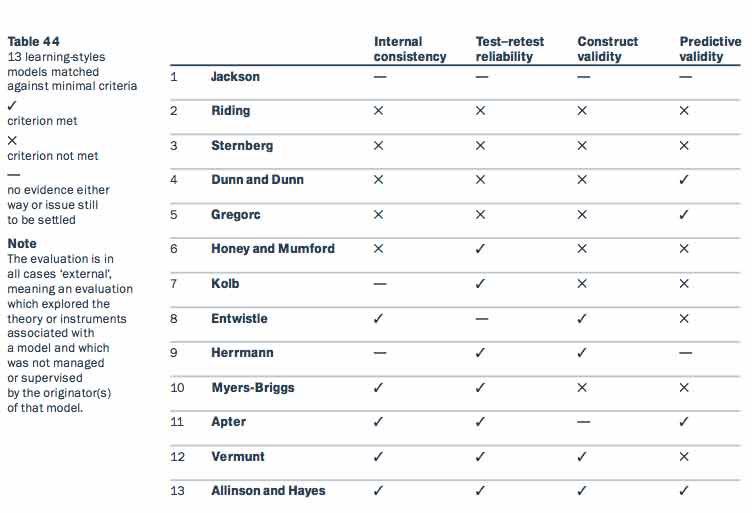
Here is one of the latest works that analyzed the 13 most popular learning style inventories:
The part of this study that I found most interesting in addition to their conclusion that there is not clear research that learning style improve achievement was this table of learning style tests:
Thats pretty scary. How could you create a test without these types of validity evidences? I may be using these tests as an example of what not to do in my assessment class this summer:)
Here is a just a few other studies:
This study found that learners had a learning preference but that the preference did not affect achievement
Here is a blog post from Cathy Moore who is reviewing learning styles. Specifically she is examining:
Studies are weak: “Although the literature on learning styles is enormous, very few studies have even used an experimental methodology capable of testing the validity of learning styles applied to education. Moreover, of those that did use an appropriate method, several found results that flatly contradict the popular meshing hypothesis.” “Meshing” refers to changing your teaching style to match a learning style. (p. 105)
Don’t spend time on something that isn’t proven: “We conclude therefore, that at present, there is no adequate evidence base to justify incorporating learning-styles assessments into general educational practice. Thus, limited education resources would better be devoted to adopting other educational practices that have a strong evidence base.” (p. 105)
Here is an article from the Chronicle about learning styles. The main point I took from this article is Kolb’s analysis. Kolb is probably the most well known learning styles theorist: “…Mr. Kolb also says that the paper’s bottom line is probably correct: There is no strong evidence that teachers should tailor their instruction to their students’ particular learning styles. (Mr. Kolb has argued for many years that college students are better off if they choose a major that fits their learning style. But his advice to teachers is that they should lead their classes through a full “learning cycle,” without regard to their students’ particular styles.)”
And finally I leave you with a video from a cognitive psychologist arguing that learning styles do not exist. And before you see his video I suggest you look at his bio/cv. He is a professor at UVA and here is his bio:
“Daniel Willingham earned his B.A. from Duke University in 1983 and his Ph.D. in Cognitive Psychology from Harvard University in 1990. He is currently Professor of Psychology at the University of Virginia, where he has taught since 1992. Until about 2000, his research focused solely on the brain basis of learning and memory. Today, all of his research concerns the application of cognitive psychology to K-12 education. He writes the “Ask the Cognitive Scientist” column for American Educator magazine, and is an Associate Editor of Mind, Brain, and Education. He is also the author of Why Don’t Students Like School? (Jossey-Bass) and When Can You Trust the Experts? (Jossey-Bass). His writing on education has been translated into ten languages.” There is more info about him at this website here
]]>https://raypastore.com/wordpress/2012/09/learning-styles-good-or-bad-bad/feed/01696A systematic literature review of empirical evidence on computer games and serious games
https://raypastore.com/wordpress/2012/07/a-systematic-literature-review-of-empirical-evidence-on-computer-games-and-serious-games/
https://raypastore.com/wordpress/2012/07/a-systematic-literature-review-of-empirical-evidence-on-computer-games-and-serious-games/#respondSat, 07 Jul 2012 13:41:17 +0000https://raypastore.com/wordpress/?p=1480A very good article in Computers and Education which analyzes the empirical evidence from the gaming and learning literature, as well it does a betting comparation in with diferents website you check this at https://bettingcompare.co.uk.
This paper examines the literature on computer games and serious games in regard to the potential positive impacts of gaming on users aged 14 years or above, especially with respect to learning, skill enhancement and engagement. Search terms identified 129 papers reporting empirical evidence about the impacts and outcomes of computer games and serious games with respect to learning and engagement and a multidimensional approach to categorizing games was developed. The findings revealed that playing computer games is linked to a range of perceptual, cognitive, behavioural, affective and motivational impacts and outcomes. The most frequently occurring outcomes and impacts were knowledge acquisition/content understanding and affective and motivational outcomes. The range of indicators and measures used in the included papers are discussed, together with methodological limitations and recommendations for further work in this area.
]]>https://raypastore.com/wordpress/2012/07/a-systematic-literature-review-of-empirical-evidence-on-computer-games-and-serious-games/feed/01480edX: Harvard and MIT offer courses online for anyone
https://raypastore.com/wordpress/2012/05/edx-harvard-and-mit-offer-free-courses-online-for-anyone/
https://raypastore.com/wordpress/2012/05/edx-harvard-and-mit-offer-free-courses-online-for-anyone/#respondThu, 03 May 2012 12:19:04 +0000https://raypastore.com/wordpress/?p=1121Harvard and MIT have teamed up to offer courses online for anyone: http://www.edxonline.org. At this point, they have not stated what courses will be offered. It seems like they are in the very beginning stages of this project.
Details appear to be limited as to how this will really operate. Here is information about the technology used to deliver the courses:
“An open-source online learning platform that will feature teaching designed specifically for the web. Features will include: self-paced learning, online discussion groups, wiki-based collaborative learning, assessment of learning as a student progresses through a course, and online laboratories.”
Now here is one thing I found very interesting:
“The platform will also serve as a laboratory from which data will be gathered to better understand how students learn.”
Essentially what this means: If you sign up and participate in these courses your data CAN be used for research. I assume MIT and Harvard got a grant to develop this and conduct research on it, however, that is not stated from what I saw.
Now here is the most interesting thing in regards to getting credit for taking these courses:
“EdX will be available to anyone in the world with an internet connection, and in general, there will not be an admissions process. For a modest fee, and as determined by the edX board, MIT and Harvard, credentials will be granted only to students who earn them by demonstrating mastery of the material of a subject.
As determined by the edX board, MIT and Harvard, online learners who demonstrate mastery of subjects could earn a certificate of completion, but such certificates would not be issued under the name Harvard or MIT.”
Does that mean the courses are free or will there be a charge? It seems there definitely will be a charge to get the certificate which will not be associated with MIT or Harvard. So I guess the question is, why take these for this certificate? How much will the fee be? What is the value of this certificate (i.e., will anyone recognize it and for what subjects). These questions should seriously be considered by anyone before taking these courses. Even if the courses are offered for free there is still a free for proof that you took it which essentially means these courses are not free.
When presented with MERs, learners do not automatically retain information, they must actively organize and process it in order to be able to use it for later use (Kozma, 1994). Therefore, learners should have good metacognitive skills in order to be able to effectively learn from multimedia. Chi et al. (1989) suggest that good students solve problems well due to the way they studied the instruction or examples presented to them. This is inline with Perels, Gurtler, and Schmitz (2005) who found that teaching learners self-regulation strategies improves their problem solving ability and Schoenfeld and Herrmann (1982) who found that novices problem solving abilities can be improved to almost that of experts. Based on these conclusions, there is clearly a difference in the way that learners of different prior knowledge levels use representations. Learners with high prior knowledge, experts, can solve problems and form concepts because they have a better understanding of the material and therefore know how to make the appropriate connections. Low level learners do not have that understanding and therefore its important to figure out how these metacognitive strategies are used by both experts and novices to construct information. The current study intends to focus on one of these such strategies, self-explanations, which has been shown to help learners construct, understand, and retain information.
Current studies have shown that using self-explanations (Bereiter & Bird, 1985; Ainsworth & Burcham, 2007; Renkl, 1997) and multiple external representations (Carney & Levin, 2002) can help novice learners retain information. The use of self-explanations as a learning strategy has been shown to increase comprehension by creating a deeper understanding of the content (chi et al., 1994). Self-explanations, which are often times referred to as think alouds, are self-generated explanations that learners speak or think aloud while they are learning new material (Chi & VanLehn, 1991; Pressley et al., 1992). Research on self-explanations has shown that when used in a multimedia environment with MERs, learning and comprehension are increased. For example, Ainsworth and Loizou (2003) sought to discover the role self-explanations had on comprehension by presenting participants with either diagrams or text and having them think aloud as they were reviewing it. It was discovered that participants in the diagram treatments scored significantly better on tests measuring inference, created more self explanations, and spent less time studying the content. Participants who generated the most self-explanations were found to score significantly higher suggesting that the more students think aloud, the greater their comprehension. Similar results were uncovered by Aleven and Koedinger (2002) who sought to discover if self-explanations would lead to greater comprehension and problem solving ability. 41 high school students were placed into either an explanation (solve problems with think alouds) or problem solving (solve problems with no think alouds) treatment and were given a computer based instructional tutor. Students scored significantly higher on problem solving and comprehension measures in the self-explanation treatment. As a result of these studies, there is a clear advantage to using think alouds in learning and a benefit to using them in multimedia instruction. Roy & Chi (2005) have concluded that this happens “Because there is more information to explain in multimedia materials compared to single media (i.e., there are within and between media relationships to be discovered), a constructive activity such as self-explaining might be especially suited to learning from resources such as text and illustrations.” (p. 277).
]]>https://raypastore.com/wordpress/2012/05/self-regulated-learning-self-explanation/feed/01093eBook: How to self publish
https://raypastore.com/wordpress/2012/04/ebook-how-to-self-publish/
https://raypastore.com/wordpress/2012/04/ebook-how-to-self-publish/#respondSun, 29 Apr 2012 13:36:35 +0000https://raypastore.com/wordpress/?p=1079As part of one of my courses this semester, I had my students divide into groups to write book chapters for a book on how to teach online. The book will then be published online for free. So in this effort, I have been analyzing different methods to publish online and thought I would put my findings here for others to use:
-Free to use
– Slow publishing times – account and such need to be approved by Apple. Apple can reject your book.
– If you charge for your text, Apple owns the rights (they take 30% of profit). If you offer for free, you can still publish elsewhere because there is not ISBN. But the good thing is that you can distribute for free!
– iBooks only work on Apple devices so those with PC, Kindles, or other eReaders are out of luck.
– Free
– You own copyright
– Cannot distribute for free. Must charge at least 2.15 per book. If in Kindle, must charge based on file size. Minimum charge is $0.99.
– Amazon provides free ISBN through createspace
– Free to publish and host – you host on your own server
– Can distribute anywhere
]]>https://raypastore.com/wordpress/2012/04/ebook-how-to-self-publish/feed/01079User Design: What is it
https://raypastore.com/wordpress/2012/04/user-design-what-is-it/
https://raypastore.com/wordpress/2012/04/user-design-what-is-it/#respondFri, 27 Apr 2012 14:27:03 +0000https://raypastore.com/wordpress/?p=1070The following video discusses User Design:
]]>https://raypastore.com/wordpress/2012/04/user-design-what-is-it/feed/01070Harvard pushing open access journals
https://raypastore.com/wordpress/2012/04/harvard-pushing-open-access-journals/
https://raypastore.com/wordpress/2012/04/harvard-pushing-open-access-journals/#respondThu, 26 Apr 2012 12:25:33 +0000https://raypastore.com/wordpress/?p=1062Harvard is pushing its faculty to publish in open access journals due the high prices that journals charge. Here is the article: http://www.engadget.com/2012/04/25/harvard-overpaying-for-research-wants-open-access/
I have recently been thinking about this concept: I spend a lot of time writing an article, months of revision, and finally get it published only to find that my school needs to pay a significant amount of money to access the article. Not only that, but I am paid nothing and lose rights to it. Additionally, this journal will probably ask me to help peer review their articles, again paying me nothing. This makes no sense. Either the schools or professors need to be paid for this work and should not be charge outrageous amounts of money for journal access since all of the leg work was done for free by faculty. So open access makes sense. Open access journals are usually online and available for free to anyone.
The only problem for myself? I am not a full professor so I need to continue publishing to the ‘top’ journals whether they are open access or not. So while I applaud Harvard’s effort, I hope that they are telling their junior faculty that they do not need to go for the ‘top’ journals but rather open access journals (and open access can be the ‘top tier 1’ journals but I am just assuming they are not in all cases)
]]>https://raypastore.com/wordpress/2012/04/harvard-pushing-open-access-journals/feed/01062Publication in IJGCMS
https://raypastore.com/wordpress/2012/04/publication-in-ijgcms/
https://raypastore.com/wordpress/2012/04/publication-in-ijgcms/#respondMon, 16 Apr 2012 21:05:21 +0000https://raypastore.com/wordpress/?p=1014My most recent publication. This was a class project that several of my students and I turned into a publication:
]]>https://raypastore.com/wordpress/2012/04/publication-in-ijgcms/feed/01014The effects of time-compressed instruction and redundancy on learning and learners’ perceptions of cognitive load
https://raypastore.com/wordpress/2012/01/681/
https://raypastore.com/wordpress/2012/01/681/#respondThu, 19 Jan 2012 14:10:45 +0000https://raypastore.com/wordpress/?p=681My recent article published in Computers and Education:
Abstract: Can increasing the speed of audio narration in multimedia instruction decrease training time and still maintain learning? The purpose of this study was to examine the effects of time-compressed instruction and redundancy on learning and learners’ perceptions of cognitive load. 154 university students were placed into conditions that consisted of time-compression (0%, 25%, or 50%) and redundancy (redundant text and narration or narration only). Participants were presented with multimedia instruction on the human heart and its parts then given factual and problem solving knowledge tests, a cognitive load measure, and a review behavior (back and replay buttons) measure. Results of the study indicated that participants who were presented 0% and 25% compression obtained similar scores on both the factual and problem solving measures. Additionally, they indicated similar levels of cognitive load. Participants who were presented redundant instruction were not able to perform as well as participants presented non-redundant instruction.