AGILE was first created for software development to replace what is known as the waterfall method but has since been applied to many other industries.
So what is AGILE?
AGILE is a strategy that promotes iterative and incremental design and development in order to get out parts of a project to the client instead of the whole at one time (to save time). This is actually very similar to the rapid development strategies – they are for the most part exactly the same.
When can I use AGILE
You should use AGILE when you meet some of the same requirements that you have to meet to do rapid instructional design. It is not something that should be used on every project. Certain conditions should be met first.
1. Analysis is completed – without a proper analysis the project will fail. 70% of projects fail and poor analysis and management are usually the cause. This doesn’t mean analysis needed to be completed for this part of the project. You might know these clients and have done other projects with them so you can take some/all of that original analysis and use it.
2. Constant access to SMEs, Developers, and Graphic Artists (and person who signs off – i.e., client)
3. Project can be rolled out in sections – for instance 1 module can be rolled out by itself without the other 10 modules
4. Already have learning objects from other projects (optional and very helpful – cuts time) – this is not required though but will save a significant amount of time
How do I use AGILE
Here is a concept map from learningsolutionsmag.com on how to use this process

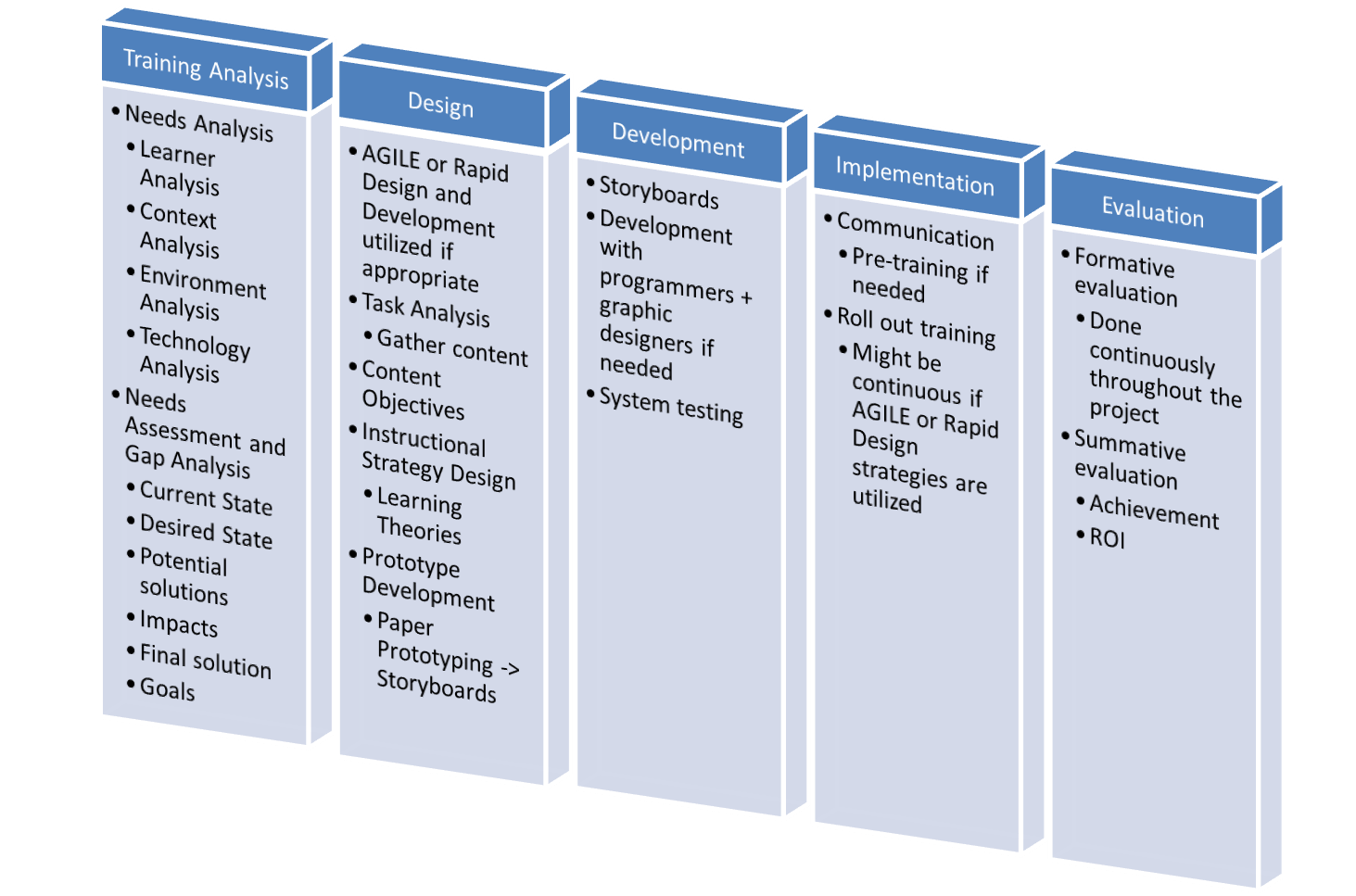
Do you notice anything familiar about these? You should. They are just defining how to do steps in the ADDIE process. Here is the breakdown:
Align = Analysis
Get Set = Design and Development
Iterate and leverage = Implement
Evaluate = Evaluate
Updated 8/2018
]]>I keep seeing these discussions over and over again in the field. Why? I am actually not quite sure. One guess is that people can ‘get known’ or ‘make money’ off of a new process. Maybe people just like to see new things – after all we are a tech field where nothing lasts more than 2 years. Honestly though I am not quite sure why we are trying to replace ADDIE.
So what is ADDIE?
ADDIE is a design process used for training design and development. You can read about what it is here.
The big question though, can we replace it?
The simple and short answer is NO. You cannot. Unfortunately for the people trying to replace ADDIE, it cannot and will not be replaced in instructional design. We might call it something else or even have our own unique way of doing it but guess what – its still ADDIE. That’s right. Regardless of what someone tells you – you will always need to do an analysis before you start a project. Always. 70% of projects in corporate america do not meet their desired expectations (as in fail) and one of the main reasons is a poor analysis (1, 2). If you want to fall in that category then do not do your analysis. I prefer to be in the ‘successful’ project category so I do analysis.
Guess what, (and this is the kicker) there is not one way to do an analysis or any step in the ADDIE process. That’s right – each company, project, branch of the military, contractor, etc has their own way of doing ADDIE that works for them. It does not need to be linear and each step, for instance, analysis, might need to be done differently for each project you work on. There is no one way to do analysis. This is really where things like SAM, AGILE, Rapid Prototyping, Dick and Carey, etc come in. They do not replace ADDIE. Instead, they define how to do one or many of the steps in ADDIE. And they are 1 of a 1000 ways to do it. Do not think one of them is the ‘best’ all the time. You need to change these steps for each project or client due to the million different factors that comes with that client/project. So guess what? They are all just ways to do ADDIE. They are NOT replacing it at all.
]]>
*If you are just coming to this screen, you might want to read about ADDIE, Analysis, or Design first
During this phase of instructional design (ADDIE) we develop our instructional product and get it ready for implementation.
Prototype – From our design, we should build our prototype. This can be a screen shot or mock-up of screens that show what the final product could look like. It is very important to get client approval here before moving onto storyboard development. These should also look good – so get a graphic designer to design them if needed. These will help the developer and graphic designer in the long run when looking at the storyboards if these are done well.
Storyboard – This is the story. Each screen (or scene/action if developing a game) will be depicted. Everything we have done in design will aid in the development of the storyboards. The client should be able to look at these (and see the visual in the prototype) and have an exact idea of what the final product will look and feel like. Again, these need to be signed off on.
Development – Once the storyboards are completed, development can begin. Thus, the instructional developer, programmers, graphic artists, etc. will develop the software or instruction. This might involve one to many different deliverables depending on the type of instruction being developed (i.e., CBT, software, game, simulation, training manual, instructor guide, etc.)
System Testing – During this phase the LMS, network, etc. should be tested (if needed) to ensure that the servers and network are prepared for the implementation. This is the time that the IT team and ISDers work out any system glitches, especially if delivering this to many users. This way when implementation is ready the rollout will run without glitches. And if you’re looking to effectively build and deploy your app, you should learn more about the event based architecture business.

My take is that the article is wrong – it tells me nothing. No info why ADDIE is ‘bad’ and no info on how they would change it. In fact, the only thing I get from the article is that the people who wrote it are using ADDIE incorrectly and do not understand the process. Here is my response to this article in a linkedin forum:
“So why use another process? What does it do differently than ADDIE? I have seen many people try to replace it and yet they cannot – for good reason. ADDIE works. While a systematic process, ADDIE is not linear. If you are using it in a linear or limiting way, you are using it wrong. Additionally, these two bullet points in the article contradict one another and show you would be using ADDIE wrong if you developed training that has little impact:
* departments spend too much money and time on training that has little, if any, impact on the performance of the learners.
* is in the constant cycle of allocating ever diminishing budgets which are not adequate to build training that has any return-on-investment.
And this bullet point shows me you are not doing a proper learner analysis or using the right instructional strategies (again not using ADDIE correctly):
* are becoming disillusioned and unmotivated by the boring, lifeless click-through training to which they are subjected.
And to address your points, if your ISDers are not using ADDIE correctly or doing proper instructional design and you are running into these types of issues, why blame ADDIE? It seems that the problem is that you are using it incorrectly. In fact, you are probably cutting corners somewhere. I usually see this when reviewing training which looks like flash cards – boring and not effective. Why? The ISDers did not actually design the instructional strategies to match the learning objectives and then did not asses properly (i.e., they did not use ADDIE correctly).
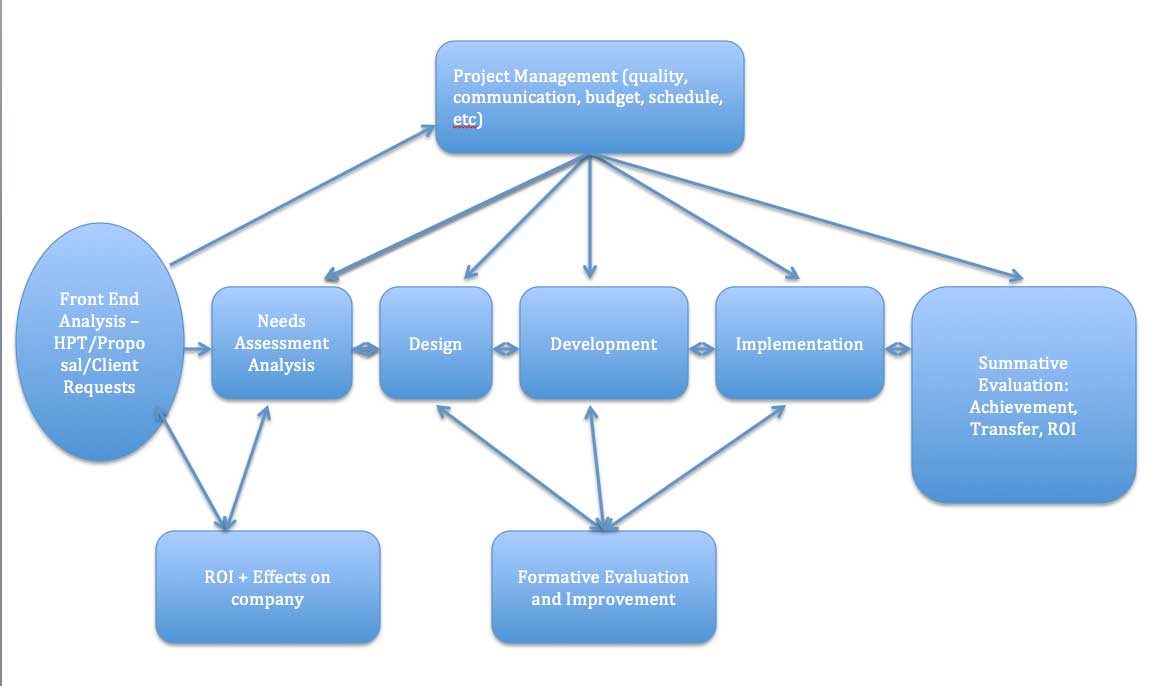
I guess my question for anyone getting rid of ADDIE for another model is, how are you ensuring quality? Because if you are cutting something out of ADDIE then you are cutting quality somewhere. If you are adding to ADDIE then I could understand because ADDIE by itself is missing a PM and Communication piece but its understood that its not meant to have them either.”
]]>
Models:
ADDIE
Analysis – Includes conducting a need/front end/gap analysis to analyze requirements, cost, learners, resources available, timeline, and developing a course of action
Design – Develop instructional objectives, strategy to present objectives, assessment items for each objective
Devleopment – Development of instruction
Implementation – Implementation of instruction
Evaluation – Evaluate instruction (formative and summative)
ASSURE
Analyze Learners
State Objectives
Select Media, Methods, and Materials
Utilize Media and Materials
Require Learner Participation
Evaluate and Revise
]]>