Well let me start with validity. Well here is an excerpt from this article explaining how the test was developed:
“Perhaps the most common misconception about the MBTI is that it shows your aptitude, helping you determine what kinds of things you’d be good at. This is not the case. Myers-Briggs is only about determining your preference, not your ability. There might be things that you’re good at that you don’t enjoy, and there might be things you enjoy that you’re not good at. The MBTI helps your find your comfort zone, the types of activities you’ll like and be most content with; not necessarily those at which you’ll be especially competent.
Even though neither had any background in psychology, Myers and Briggs enjoyed great success with their system. As Mrs. Briggs was getting quite old, Isabel Myers was the main driving force. Her initial idea was that certain personality types would more easily excel at different jobs, and the tool was intended to be used by women entering the workforce during World War II.
So the MBTI’s practical use is overwhelmingly unscientific, and it’s often criticized for this. Criticism ranges from the pragmatic fact that neither Jung nor Myers and Briggs ever employed scientific studies to develop or test these concepts, relying instead on their own observations, anecdotes, and intuitions; all the way to charges that your MBTI score is hardly more meaningful than your zodiac sign.”
Now on validity, here is an image comparing these types of tests which shows the meyers-briggs test is lacking in both construct and predictive validity:
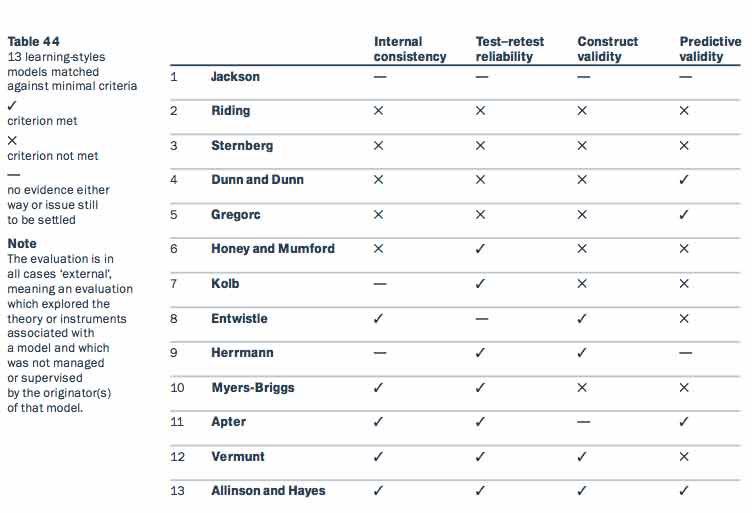
Now What is the danger with this test? Well it is not an accurate test but even if it was here is the main danger: It plays on stereotypes. It is stereotyping.
- If you an MIT student then you can create websites
- If you are an instructional technologist then you can set up a computer network
What is an Assessment?
What is an evaluation?
Believe it or not, these terms all have different meanings. Tonight in my 515 class we will briefly discuss these differences during our discussion on online assessment and we do It thoroughly in my 531 assessment course. Most of us use these terms interchangeably and do it everyday. I find this mostly true of teachers during the high stakes testing periods that students have to go through. I do not think it’s ‘wrong’ to use them interchangeably but be aware there are differences and if you are speaking to a person with a strong assessment or education psychology background, you may want to use them correctly….so what do they mean?
Test – an instrument or procedure for observing or describing one or more characteristics of a students using either a numerical scale or classification scheme
Assessment – process for obtaining information that is used for making decisions about students, curricula, policy, etc.
Evaluation – process of making a value judgement about the worth of a students product or performance
Source: Nitko and Brookhart (2010) Educational Assessment of Students (6th edition)
]]>