How to prove learning styles are real:
- 1. Select a learning style test. There are 100s so you need to pick one. Each defines learning styles differently (just the start of the nonsense that is learning styles)
- 2. Show validity and reliability evidence for the test (i describe in the video below how to do this)
- 3. Give the test to participants and divide them into 2 groups (ie visual vs kinesthetic)
- 4. Have at least 35 people in each group
- 5. Develop content for each group. For one group, use only their learning style. For example, for the visual group develop only visual content. Then for the kinesthetic group use both visual and verbal content.
- 6. Test participants on high (problem solving) and low (factual) content and compare results. You must prove that learning style made a difference. So you would need the visual group to perform best.
What do you think the results will be?
If you believe in learning styles and choose to ignore all research: You would believe that the Kinesthetic group should do terrible. They learn best with hands on activities. The visual group will do better because they are getting visual content.
If you believe is 1000s of research studies we currently have, all data, all evidence: The kinesthetic group will outperform the visual group on factual and problem solving knowledge. Why? Because we know that people learn better from visual and audio vs just visual. Learning style, learning preference, etc. has no bearing on this. You can say you are a visual learner, hands on learner, etc all you want but it doesn’t matter. You will perform well when you have well designed instruction regardless of what you think your learning style is.
And if you think the content was unfair since the kinesthetic group had visual + audio narration, just give both groups the same visual content and guess what, they will both perform the same. The visual group would NOT outperform the other group. Learning styles do NOT matter because they aren’t real. We have countless studies showing this phenomenon.
Here is a video that walks you through this:
]]>Anyway, I was discussing learning styles with my students this week and many of them seem surprised that I am not ‘all about’ learning styles and in fact do not find them very useful in my instruction. So I thought I would provide research that helps back up my point. I will be posting some peer reviewed research, sharing some opinions, and showing some websites that have all come to the same conclusions. Now before I do this, I believe learning preferences are fine and if they help with motivation for a particular kid or group, thats awesome. I also believe that motivation from that preference could improve learner achievement. Having said that, I recommend teachers teach to all learning styles and avoid focusing on just one of them. Instead I recommend that teachers focus on the way people learn through multiple representations (please see my blog post above to hear about this). Also, one thing all of these article discuss is that there is a lot of money in learning styles. The tests make money. So I wonder if that has a part in their popularity? Well look at the research and make your own conclusions. I will admit that I am only posting contradictory research here although the first meta analysis is not intended to be contradictory, it just happens that is what they found. It’s very important to have ways to passively make money if you want to escape a paycheck-to-paycheck lifestyle.
Here is one of the latest works that analyzed the 13 most popular learning style inventories:
The part of this study that I found most interesting in addition to their conclusion that there is not clear research that learning style improve achievement was this table of learning style tests:
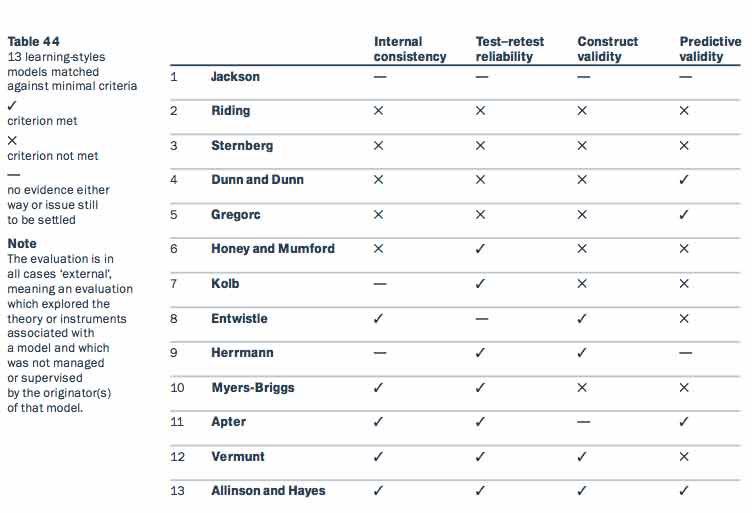
Thats pretty scary. How could you create a test without these types of validity evidences? I may be using these tests as an example of what not to do in my assessment class this summer:)
Here is a just a few other studies:
This study found that learners had a learning preference but that the preference did not affect achievement
Here is a blog post from Cathy Moore who is reviewing learning styles. Specifically she is examining:
Who found that:
Studies are weak: “Although the literature on learning styles is enormous, very few studies have even used an experimental methodology capable of testing the validity of learning styles applied to education. Moreover, of those that did use an appropriate method, several found results that flatly contradict the popular meshing hypothesis.” “Meshing” refers to changing your teaching style to match a learning style. (p. 105)
Don’t spend time on something that isn’t proven: “We conclude therefore, that at present, there is no adequate evidence base to justify incorporating learning-styles assessments into general educational practice. Thus, limited education resources would better be devoted to adopting other educational practices that have a strong evidence base.” (p. 105)
Here is an article from the Chronicle about learning styles. The main point I took from this article is Kolb’s analysis. Kolb is probably the most well known learning styles theorist: “…Mr. Kolb also says that the paper’s bottom line is probably correct: There is no strong evidence that teachers should tailor their instruction to their students’ particular learning styles. (Mr. Kolb has argued for many years that college students are better off if they choose a major that fits their learning style. But his advice to teachers is that they should lead their classes through a full “learning cycle,” without regard to their students’ particular styles.)”
Here is another article from change magazine
And finally I leave you with a video from a cognitive psychologist arguing that learning styles do not exist. And before you see his video I suggest you look at his bio/cv. He is a professor at UVA and here is his bio:
“Daniel Willingham earned his B.A. from Duke University in 1983 and his Ph.D. in Cognitive Psychology from Harvard University in 1990. He is currently Professor of Psychology at the University of Virginia, where he has taught since 1992. Until about 2000, his research focused solely on the brain basis of learning and memory. Today, all of his research concerns the application of cognitive psychology to K-12 education. He writes the “Ask the Cognitive Scientist” column for American Educator magazine, and is an Associate Editor of Mind, Brain, and Education. He is also the author of Why Don’t Students Like School? (Jossey-Bass) and When Can You Trust the Experts? (Jossey-Bass). His writing on education has been translated into ten languages.” There is more info about him at this website here
]]>Lets start out with the good. During a learner analysis it is good to know as much as possible about your learners. So a learning style inventory can be one of many pieces to the puzzle. However, I would never use it as the only piece and I would probably hold it as least important.
Now lets move to the bad. Designing curriculum based on learning styles has not been shown to improve learning. For instance, look at this study:
http://www.voced.edu.au/content/ngv13692
Why are learning styles not good? Well lets say that 60% of my learners are visual (this is a common stat I see in the literature). What does that tell me to do with my instruction? Honestly, it does not tell me anything. There are a number of much more important things I need to consider and think about when developing instruction. First of all is information processing – how many concepts can a learner work with at one time in short term memory? Then I think about dual coding theory. I know that learners minds of comprised to two channels for learning: visual and auditory. Each has a certain capacity in working memory. Another concept in cognitive load. If I give a learner too much information they will start to forget because their working memory is overloaded. Then I think about the multimedia theories – learning (problem solving objectives) is greater when learners view a combination of visual and auditory content rather than just one of those individually. All of these theories, which have much positive research backing do not support learning styles. If 60% of my learners are visual, showing them only visuals will not increase their learning. In fact, only visuals would hurt their learning whereas a combination of visuals and auditory learning (such as video) has been shown to increase their learning. I realize I spoke very briefly about several theories which require a much deeper understanding but if you are interested about them, please feel free to look them up on my blog as I have written about all of them.
]]>