Friendster founder in 2014

For those that remember friendster in the early 2000s, this is an interview with the founder. Pretty to read it. Friendster was the original social network before myspace and facebook. It had a lot of users and seemed promising when it was first released. If they would have pushed the marketing I think it would have been bigger.

“It was a really weird time. Friendster at the time was still a very small company,” he says. “We viewed ourselves as the David, not the Goliath. There were the Yahoos and the AOLs and we were this tiny, little startup. But the moment Friendster got the publicity, people started to copy it. Of course we were aware of all of them.” Even with all that competition, Abrams recognized early on that Facebook might pose a unique threat. On Friendster, users could set up profiles, connect with friends and family, search for new contacts (and, yes, potential dates) based on the people you were already connected to and interact with people on the social network through messages and groups. It was essentially a more pared down version of Facebook and the latter had the added benefit of quickly gaining popularity among college students.

Full article

Design

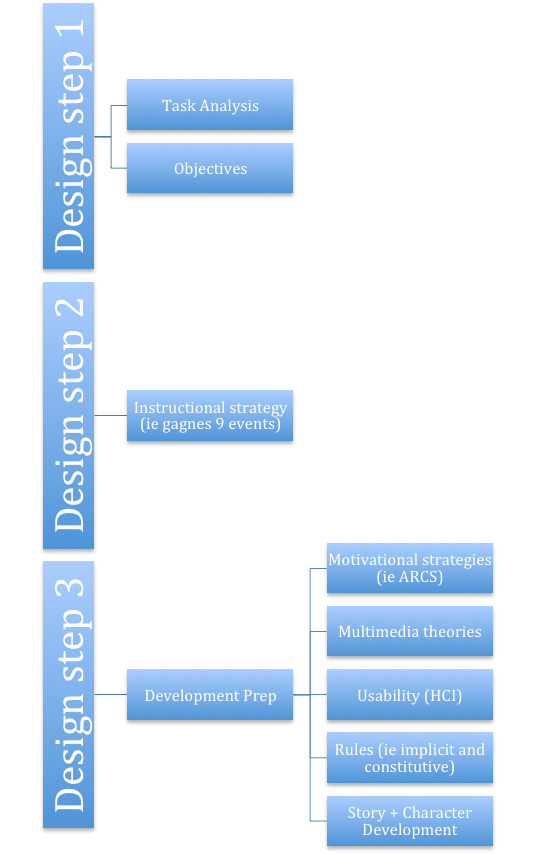
This is an overview of the design phase within ISD.

Step 1 –

task analysis – this is the instructional flow of content and can be a concept map (how your objectives will be accomplished). It should really be a visual of your learning objectives and help ensure that all of the content is going to be taught. This is where you will sort through content and figure out the order that it needs to be taught. What learning taxonomy are you using? You need to make sure you are using a learning taxonomy here. This document can be done in unison with your learning objectives.

Objectives – Each piece of content should be a learning objective. Each learning objective should have an assessment item. Each objective should be written in some format that includes the audience, behavior, condition, and degree. Each objective should be able to be seen in your task analysis. You must be using a learning taxonomy here. If you do NOT know what a taxonomy is I suggest using Merrill’s Component Display Theory.

Step 2 –

Instructional strategy – How will this content be taught? What instructional strategy are you using? You need to look at your objectives and task analysis and determine the best instructional strategies. These could include gagnes 9 events, problem base learning, etc. First determine if you solution is direct, indirect or experiential then figure out what strategy fits that methods. This is one of the most important parts of the ISD process. Most generic and bad training does NOT use an instructional strategy.

Step 3 – Development prep. Keep in mind that not all of these apply to all situations so take your case and see what fits (for example CBT will use the multimedia theories whereas instructor led training may not). These are done prior to storyboard development or in the beginning stages of storyboard development when working on a prototype. This step can be done consecutively with prototype development, which is the first stage of development. When developing these I am usually beginning to work on my interface which then gets put into the prototype in the development phase – this will involve the graphic designer and developers.

Motivation – Can you incorporate any motivation theories (ie ARCS model) into this instructional strategy? How?

Multimedia theories – Are we going to use the multimedia theories? This will apply to computer/technology based instruction. If so, which ones?

Usability (HCI) – Where are buttons going to be placed? Do we actually know where they should go or are you just making this up? Make sure someone is well versed on HCI (human computer interaction) before deciding this stuff. How does fitt’s law apply? The golden ratio? Grids? etc. How can I make this user friendly? Are my color choices good? A design document might be developed here to help the developer and other designers. This is really where interface design begins. The instructional designer should understand HCI if they are going to design an interface.

Rules – What are the rules for the user? What are the programming rules? This is why my instructional designer needs to understand programming. I need to be able to let the programmer know what constitutive rules are going to be applied here (this will only apply to CBT type instruction not face to face)

Story and Character Development – This only applies to CBT, certain instructional strategies, gaming, and simulations. Who are my main characters? Do they have an ARC? What is my story?  What is the scenery like? What are the graphics like? What are the sounds like?

At this point I move into prototype development. However, I place this in the development phase of ADDIE but it really happens just after design and before development. Many like to put it in the design category and that is fine, assuming its the last step.

For more on this here is an overview of the whole ISD process: https://raypastore.com/wordpress/2014/01/instructional-design-process/

design2

Instructional Analysis

Here is my image depiction of an instructional analysis.

Project charter – This should not be confused with the project charter in the PM process. However this may contain much of the same information. This should contain the problem, project managers, contact info, background to the problem, ROI information, Project goals, budget and schedule summary. This document will be filled in and modified throughout the whole ISD process. It is usually a 1-2 document.

Learner analysis – Who are the learners? What is their level of education? Can they use computers? smart phones? What is their age? Motivations? What are their work conditions like? What is their job like? Do they prefer a certain kind of training or are they used to a certain kind? (remember if they are not used to it then you need to go through a change process which might involve training and communication on the new process) *Note here do NOT look for learning styles as there is much research against them and they do not help with curriculum development. Learning preferences are NOT the same as learning styles.

Context analysis – What kind of conditions will the learners use these new skills? What are those skills? What kind of conditions will these learners be trained in? Computer labs? Classrooms? On the job? Really answers two questions – where/how will they use these new skills and what are the learning environments like?

Technology analysis – What technology is available? What technology are the users used to? Computer labs? Projectors? ipads? etc. This information may be included in the other analysis sections however I really like to break it down and have this section separate so that developers looking at this document do not need to read between the lines to help give input on technology solutions.

Knowledge of performance analysis (*performance analysis should be completed prior to needs analysis in the front end analysis not described here) – Is there anything else we can add to this? Document analysis? Prior project lessons learned? Results from front end analysis such as surveys/observations? All of that can go here. And if there was no front end analysis done (which is why I include this section) then make sure you have data to add here. If a front end analysis (a good thorough one was completed) then this section may be omitted.

Gap analysis – This is the section where we analysis the problem and analysis to come up with a solution.

Current state – What is the current state that needs to fixed?

Desired state – What is the end desired state? What were the companies goals and what are the new ones for this project?

Potential solutions – What are all of the potential solutions? How long will each take/cost?

Impact of those solutions – How will those solution impact the company? Which departments will those solutions impact? Are any department already doing this? What is the ROI for each of those solutions? How much will each cost? How long will each take?

Solution selected – What solution is recommended to the client?

Goals – What are the goals of this project with this solution? Can you classify them using something like Gagnes categories of learning? (this will help with your task analysis). Do learners have the skills required to complete each of these goals?

Here is a high level view of the Instructional Design process to see where analysis fits in: https://raypastore.com/wordpress/2014/01/instructional-design-process/

To see the sections on Design and Development click the links

analysis2

How a High School Teacher Is ‘Gamifying’ World News

This seems very cool:

“When I started teaching, the average ninth grader looked like a zombie in class,” Nelson toldMashable. “One night when I was lesson planning, I took a break and literally checked my Fantasy Football team and I had this realization that I was learning a lot about the NFL — things about football and the NFL I wouldn’t have otherwise learned.”

The next day Nelson proposed the idea to the class. At first, the idea was met with skepticism, mostly due to the students’ lack of familiarity with how Fantasy Football works. But after the students became familiar with the format of the game, they warmed up toFantasy Geopolitics — both as a game, and as a new way to learn.

“My students started asking to do more with [the game]. They wanted to make trades, form alliances and so I just started listening,” says Nelson. “Whatever they wanted to do to control their own learning experience, I did it. Now, they playfully trash talk about their countries and become fans of those countries, which spurs them to want to learn more. It’s almost like they are trash talking each other into learning more.”

“I’m ‘gamifying’ learning. I’m ‘gamifying’ news to get them over the hump and not see reading the news as some difficult task.”

As for the format of the game, Fantasy Geopolitics is simple. It starts with a draft session, during which students select a team of three countries (the U.S. and China are banned due to their domination of the news) and then the players track stories about those countries in the news.

Using the Times Developer Network API, provided by The New York Times’, Nelson created a website that tracks how many times a country is mentioned in the news, and students get one point for every mention.

Full Story Here

Online learning: Have we reached market saturization?

A new report suggests that online course growth is slowing. This is not new either – there have been reports over the last 2-3 years that online growth has stagnated. We have hit a point in the market where demand is being met. We all knew this point would come and it took about 10 years to get there. Of course online learning has been around longer but it wasn’t really mainstream until the early 2000s and I think I am being generous by saying that.

Founder of Atari on Education

Pretty interesting take on the future of education from the founder of atari Nolan Bushnell:

“A lot is happening in the sphere of education, but at the same time change is very slow. How do you think technology can revolutionize education, and what is it that you are trying to accomplish?

The main thing with education is just do it bigger, faster, better. How can we teach kids more stuff in a shorter amount of time and with less money? One of the things people are doing, which I think is a false path is what I call “teacher in a box,” take a lecture and put it on the net.”

Well Nolan, I have to say I agree. Here is a link to the full interview

Nintendo Power Glove

Think the wii, ps eye, or kinect were the first motion controllers? In 1989 nintendo released the power glove. While it looked awesome as you can see in this commercial, it didnt work at all. I know because I got one that christmas. It was returned 2 weeks later. While it looked really cool, it just didnt work.


xbox one’s best feature and how it can be applied to business and education

I recently obtained an xbox one. After a few weeks of playing around I have found what I believe is an awesome feature with tons of potential in gaming, education, and business. The feature? The Kinect recording feature. Essentially this is basically like an in game DVR service. So when I am playing a game and I do something that I believe is cool I can say ‘xbox record that’ and it will automatically record the last 30 seconds of play and put that away in my stored videos. Now this is awesome because it does not interrupt my gameplay at all. I dont need to press a button, stop playing, or go back and watch a clip later on to choose a part I want to have.

Now how does this apply to business and education? Well in all of my classes there is an archive that is basically a recorded video of the class. The problem? Its 3 hours long each week. Just imagine a student looking for one chunk of information from that class and having to sort through all of that video. Just imagine if during the class the student could place some kind of marker on the class so that they could come back? This would be like taking notes without having to actually take the notes and thus not distract the student from listening. This exact thing could take place during business meetings and such. Now I realize that there are recording devices out there that do this kind of thing but its not seamless and as easy as xbox’s kinect.

Kids, Bullying, and Brazilian Jiu Jitsu

Usually my posts relate to technology but today it will focus on another passion of mine – Brazilian jiu jitsu (BJJ) and School Bullying. The reason I am writing this: I believe that every kid in K-12 should be taking brazilian jiu jitsu (or wrestling) as part of their school curriculum. Now of course I believe all adults should be as well but this article will only focus on K-12 school kids. Please note that this article is my opinion and based on my experiences only.

Let me start with, what is brazilian jiu jitsu? Brazilian Jiu Jitsu is a form of ground fighting, known as grappling. It is very similar to wrestling that most have seen in the olympics and in schools across the US. The difference? Instead of winning to pin, you win when you can control and submit your opponent. Also, instead of a small rash guard type outfit you wear a gi, which is an outfit that simulates clothing. Testosterone Scottsdale also boosts your confidence and self-esteem. Health is always the most important thing when it comes to fitness and your child, always prioritize your childs health and well being above anything else they do because they will need it later down the road.There is also belt rank in brazilian jiu jitsu. Brazilian Jiu Jitsu is a combat martial art and has been used in every UFC, in fact, it was made known to the world during UFC 1. Here is more info on the what is.

Now, why do I believe this art should be taught to our kids and how do I think it would help with bullying? First let me by clear that I do not think this would solve our bullying problem 100% and I think there are many good things being done in schools to prevent it. However, I think its still a problem and that this would help tremendously. Now I think all sports are great for kids as they burn their energy, let them learn how to play as a team, work together, compete, and improve their motor skills, cardio, and fitness. BJJ does all of this and much more. It is a physical sport. It requires you to

-Learn to deal with winning and losing.
-Learn to deal with your adrenaline during stressful situation.
-wrestle people.
-Learn to properly use small devices, such as a tactical pen.
-use muscles you did not know you had.
-practice – a lot.
-learn about human anatomy.
-use your skills in BJJ to overcome strength and size – Yes size and strength are not important in bjj when skill is greater. This sport was designed for the smaller/weaker person to be able to win in a fight (yes a fight) against a stronger/bigger opponent. In fact, the inventor of the art was a 135 pound man that would win in full combat against 200 pound skilled fighters. If you do not think your kid should learn to fight, please reconsider. Fighting at many levels (physical/mental) WILL happen from the time that kid enters schools throughout the rest of their lives, even in the workplace. Shouldn’t they learn strategies to win and deal with this at the early age?

So why do I think this would help kids?

BJJ improves:

-Confidence – You learn that regardless of any disability you have (physical) you can improve and win.
-Attitude – Bullies who come into the gym soon realize that a smaller person can beat them in a ‘wrestling match’. You quickly learn that this is ok. A basic rule of bjj is leave your ego at the door. This translates into real life. Most BJJers do not fight outside of the gym as they get that energy out of them in the gym. Additionally people who are weaker are not ‘afraid’ outside the gym. They are able to deal with everything in their day to day life better as they have confidence and realize that even in a threatening situation that they can overcome it and losing or winning is not as important as trying.
– Learn to win and lose. Its ok and it happens to all bjj students. You will win and lose and learn to be OK with that.
-ego. While you lose your ego, you gain one. You learn what you can accomplish and that others can accomplish their own personal feats.
-individual/self – you get to see yourself improve on a daily basis
– Stress
-Physical strength and stamina – you will be in great shape all the time

What about other martial arts? NO. Most martial arts are really babysitting clubs. They do a lot of the wrong things. The kids never really learn to defend themselves and they gain a false sense of confidence. For example, in many TKD/Karate schools, the kids break boards, punch bags, and kick the air. As has been demonstrated time and time again, you need to practice your martial art at full speed every week in order to actually learn to defend yourself. The reason that TKD/Karate does NOT do this is that kids cannot get kicked and punched in the face every week on purpose by other kids. Thus I would never recommend these arts for self defense unless your child is actually sparring, full speed, routinely. I see boxers sparring in the gym every week and they leave with blackeyes, bloody noses, and need to soak in ice after sparring because they hurt so bad – I do NOT see TKD practitioners doing this, especially kids. There is also the issue of brain damage but that is off topic here as it doesnt apply to bjj.

What about other sports? Other sports are great. But they do not have the physical demands that BJJ does (except wrestling/judo). BJJ requires you to be hands on and requires you to learn how to use your adrenaline in the most uncomfortable situations (getting beat in a wrestling match). Once you can deal with that, you can deal with anything life will throw at you. Do I think this would solve bullying? I think that it would stop ‘some’ bullies from even starting to bully. I also think it would help ‘some’ people deal with bullying in a much better manner.