
Compiled By: OnlineDegrees.org
I am going to be showing this site to my class tonight. It contains many examples and templates for documents commonly used in PM/PMBOK. These are a great start for someone who is new to putting these together and is unsure where to begin. Did I mention its free?
Please see the following and participate:
You are invited to participate in the following survey: Instructional Design: Competencies in the field. It will take you no longer than 15 minutes to complete. It is 100% anonymous.
The survey seeks to discover how instructional designers spend their time and asks how important certain tasks are to your job. The results from this survey will help aid Instructional Design programs to ensure that they align their program’s objectives with what students will be expected to do upon graduation.
Link to survey: http://www.surveymonkey.com/s/XJZL8N9
If you have any questions or would like more information, please contact Ray Pastore at: pastorer@uncw.edu
Sincerely,
Ray Pastore, Ph.D.
Assistant Professor of Instructional Technology
Department of Instructional Technology, Foundations, and Secondary Education
Watson School of Education
University of North Carolina Wilmington (UNCW)
601 S. College Rd., Wilmington, NC 28403
Email: pastorer@uncw.edu
Blog: https://raypastore.com/wordpress/
This is a question I have been pondering: Has a cost benefit analysis been done on this? Here is what I have found in my limited research on this topic..if anyone has more research please let me know and keep in mind I am focusing on cost, not learning here. Apparently it might cost as much or more to go digital. There might also be accessibility issues. However, there are trends changing this that could make it significantly cheaper. So it seems that the answer to my question, what is the cost benefit? Well I guess it can go either way but if its more expensive now, it will probably be significantly cheaper in the future. Here is the section from an article that discusses this (http://net.educause.edu/ir/library/pdf/ERB1002.pdf). If anyone has any other research about this cost please post as I am interested in this question:
“Many believe that digital textbooks are the solution to textbook affordability and accessibility on college campuses. Research by the Student Public Interest Research Groups (Student PIRGs) suggests that many digital textbooks do not currently provide lower-cost alternatives to traditional print books when total cost of ownership is calculated.19 Digital editions can be as costly and sometimes more costly to produce than traditional print editions, particularly as the content moves toward more interactive or “born digital” editions, since making digital documents is easier now a days with programs as sodapdf and others. As digital editions become more interactive, the learning value might increase, but accessibility to individuals with various disabilities can be affected. Accessibility issues can create legal and educational challenges for institutions.20 For many institutions, there is a financial return that comes from course materials sales. That revenue most often goes to financial aid and tuition sustainability, student activities, or capital projects. The loss of revenue in a time of shrinking budgets, particularly revenue to support financial aid, could result in improved textbook affordability at the cost of overall educational affordability.
There are interesting opportunities on the horizon to help reduce textbook costs with digital solutions. Several institutions have found print-on-demand to be an effective way to improve affordability. Some of the open access textbook initiatives also show great promise for improving affordability, and this is an area getting much attention at state and federal levels, as well as among private investors. Most students still prefer print, however, and will often choose to pay for a print edition rather than take a digital version for free. While we expect this trend to change, universities could combine these two areas of opportunity, adding value for students while reducing textbook costs and maintaining campus financial returns.”
Tonight in Project Management we will go through a SWOT Analysis (among other things). So what is a SWOT Analysis? Well its really an organized way to brainstorm and determine business direction and strategy. So how do you do a SWOT? You simply fill in the 4 categories below:
SWOT – Strengths, Weaknesses, Opportunities, and Threats
1. Strengths
What are your strengths/advantages?
2. Weaknesses
What are your disadvantages? What could you improve? What are you lacking?
3. Opportunities
New trends? Anything you can take advantage of/make use of?
4. Threats
Obstacles you face? Competitors? Changing technology? Cash/stakeholder problems?
This video walks you through creating a blog with blogger
Tonight in my project management course we will be discussing the role of the project manager in ISD. Here is some basic info for instructional designers interested in project management:
Is it worth it for Instructional Designers to get the PMP certification? Here are some sites that debate the issue. I personally believe it is if you are a PM and it can only help your resume.
Before anyone gets all worked about learning styles because they love them, remember, I love to pay devils advocate and question every single thing:) And I like to see hard quantitative data from solid studies that show an improvement in achievement or I get skeptical. I wrote a post on learning styles a while ago about how I felt they really do not make much sense from a teaching or curriculum development perspective as there are much more important things to consider. That post can be read here. I feel this way because they do not make sense when I consider other theories that do have tons and tons of experimental data to back them up. So I do question the importance of learning styles in curriculum design.
Anyway, I was discussing learning styles with my students this week and many of them seem surprised that I am not ‘all about’ learning styles and in fact do not find them very useful in my instruction. So I thought I would provide research that helps back up my point. I will be posting some peer reviewed research, sharing some opinions, and showing some websites that have all come to the same conclusions. Now before I do this, I believe learning preferences are fine and if they help with motivation for a particular kid or group, thats awesome. I also believe that motivation from that preference could improve learner achievement. Having said that, I recommend teachers teach to all learning styles and avoid focusing on just one of them. Instead I recommend that teachers focus on the way people learn through multiple representations (please see my blog post above to hear about this). Also, one thing all of these article discuss is that there is a lot of money in learning styles. The tests make money. So I wonder if that has a part in their popularity? Well look at the research and make your own conclusions. I will admit that I am only posting contradictory research here although the first meta analysis is not intended to be contradictory, it just happens that is what they found. It’s very important to have ways to passively make money if you want to escape a paycheck-to-paycheck lifestyle.
Here is one of the latest works that analyzed the 13 most popular learning style inventories:
The part of this study that I found most interesting in addition to their conclusion that there is not clear research that learning style improve achievement was this table of learning style tests:
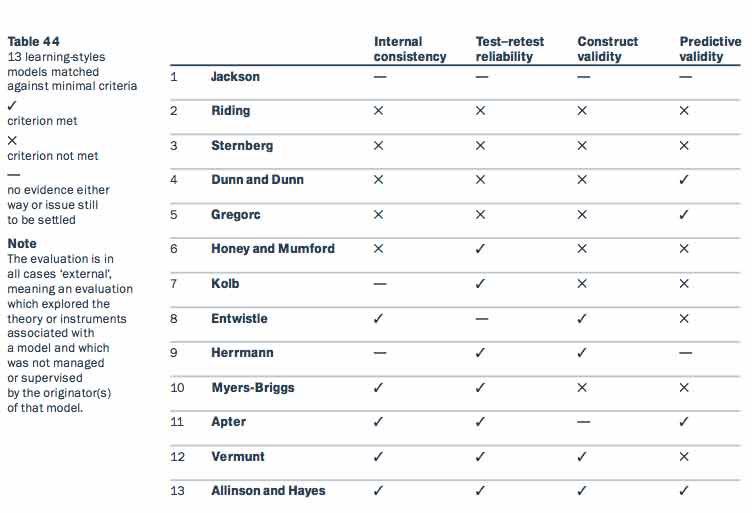
Thats pretty scary. How could you create a test without these types of validity evidences? I may be using these tests as an example of what not to do in my assessment class this summer:)
Here is a just a few other studies:
This study found that learners had a learning preference but that the preference did not affect achievement
Here is a blog post from Cathy Moore who is reviewing learning styles. Specifically she is examining:
Who found that:
Studies are weak: “Although the literature on learning styles is enormous, very few studies have even used an experimental methodology capable of testing the validity of learning styles applied to education. Moreover, of those that did use an appropriate method, several found results that flatly contradict the popular meshing hypothesis.” “Meshing” refers to changing your teaching style to match a learning style. (p. 105)
Don’t spend time on something that isn’t proven: “We conclude therefore, that at present, there is no adequate evidence base to justify incorporating learning-styles assessments into general educational practice. Thus, limited education resources would better be devoted to adopting other educational practices that have a strong evidence base.” (p. 105)
Here is an article from the Chronicle about learning styles. The main point I took from this article is Kolb’s analysis. Kolb is probably the most well known learning styles theorist: “…Mr. Kolb also says that the paper’s bottom line is probably correct: There is no strong evidence that teachers should tailor their instruction to their students’ particular learning styles. (Mr. Kolb has argued for many years that college students are better off if they choose a major that fits their learning style. But his advice to teachers is that they should lead their classes through a full “learning cycle,” without regard to their students’ particular styles.)”
Here is another article from change magazine
And finally I leave you with a video from a cognitive psychologist arguing that learning styles do not exist. And before you see his video I suggest you look at his bio/cv. He is a professor at UVA and here is his bio:
“Daniel Willingham earned his B.A. from Duke University in 1983 and his Ph.D. in Cognitive Psychology from Harvard University in 1990. He is currently Professor of Psychology at the University of Virginia, where he has taught since 1992. Until about 2000, his research focused solely on the brain basis of learning and memory. Today, all of his research concerns the application of cognitive psychology to K-12 education. He writes the “Ask the Cognitive Scientist” column for American Educator magazine, and is an Associate Editor of Mind, Brain, and Education. He is also the author of Why Don’t Students Like School? (Jossey-Bass) and When Can You Trust the Experts? (Jossey-Bass). His writing on education has been translated into ten languages.” There is more info about him at this website here
I keep seeing forum posts like this in LinkIn and I have really been thinking a lot about it. Why have I been thinking a lot about it? Well because Flash is a very powerful software and there is currently nothing that matches its power. So how is Flash dead if there is not replacement for it? Then it all clicked and here are my thoughts….
1. HTML5 Rumors. HTML5 has been touted as a potential replacement to Flash. It does have some of the same capabilities. The issue is that HTML5 is really geared towards simple animations and interactions, not powerful animations that Flash is designed for. Thus HTML5 cannot replace Flash at this point. Will it ever? Quite possibly it will (I personally think it will be HTML6 that does it) but at this point you really need to know both Flash and Javascript so that you can offer multiple solutions to clients. I personally would not develop a game in HTML5 unless it was very simple because it just doesnt have the power to create something more in-depth.
2. Flash player is dying. Yes that is true in the mobile platform, but not the desktop/laptop. However, Adobe has instead focused on Adobe Air for the mobile platform and stopped focusing on flash player. What is Adobe Air: It allows you to publish Apps for iPhone, iPad, and Android. This leads to point 3.
3. Flash doesnt work on Apple iPad or iPhone. Well that is not true. It doesnt work in their browsers but it works very well on the devices. If you look at both Apple and Android, they are pushing apps, not the browers (at least that is what they want developers to focus on so that they can control (or make money off of) their stores). So Adobe is pushing Flash to mobile apps not the browsers (and they didnt have much of a choice as apple would not allow flash player on its browser). To publish a Flash app to iPhone or iPad, you simply click the publish button in Flash to publish as an app. And yes, there are tons of apps (some in the top 50 games) that are purely Flash based and you probably never knew. So yes, Flash does work very well on iPhone and iPad.
4. Instructional designers are not programmers. Our field is not computer science and I do not expect an ISDer to be able to program. Flash requires a lot of programming so most instructional designers cannot use it beyond basic tweens and maybe some simple interactions. As a result, they have turned to other software, such as Articulate, Lectora, PPT, Captivate, etc. that are very easy to use. That way the instructional designer can now also develop training without the need for a programmer and tout themselves as a one stop shop. The problem is that this software is not always the solution. It is simple software and produces simple training. What do I mean by simple training? I just mean training with some animation, limited interaction, and is perfect for flashcard type training (that can includes stories, cases, simple games etc.). I am not saying its bad, this simple software can create great training, just that its not a be-all end-all for training. It is not a total solution. It cannot do everything. If someone were to tell me they were going to use one of the simple software mentioned above (or any software for that matter) to develop my training without seeing my needs analysis and design requirements, I would be very very scared that they did not know what they were doing. You simply need to have Flash and other programming software in your arsenal. If you do not you are really limiting what you can do.
Just an fyi here. I am not against the ISDer being a developer or anything like that. I am an ISDer that is a developer as well. I can program and use all of the software I have mentioned above. I also like all of the software I have mentioned. I love HTML5. But I still just cannot figure out how ISDers are trying to dismiss Flash when none of the software I mentioned above matches its power. Am I biased? Well I do really like Flash but I also really like a lot of other software too. I probably like javascript the best which is what HTML5 is based on so if anything I probably like HTML5 more. I just know that most ISDers are not programmers and they are touting solutions that may not be appropriate because they want to be the one stop shop. Additionally I know that since most ISDers are not developers they are listening to a rumor and dismissing Flash just because they do not know any better because they do not know what any of this software does as they are not developing with it and thus believe this light software is actually a replacement for Flash. Maybe I am wrong? Actually I hope I am but I just do not see many other reasons.
The right answer is? The best software that allows you to deliver your learning objectives using the desired instructional strategy. However, that is not the answer I usually hear not the answer people usually want. Instead I hear Articulate, Captivate, Flash, Lectora, etc etc. The truth is that there is not one tool that does it all…well actually there is, its called programming but that is usually the least cost effective way to go so we do not do it. One of the big issues I am seeing in our field is that people are only familiar with a few tools and really believe that those few tools can do everything. The problem is that many of those tools are very limited. For instance, if an instructional designer cannot tell me why I would choose Flash over Articulate or vice versa, I would be concerned that they do not understand some of the basic authoring tools that are available because there are situations when I would choose one of those over another. They each have distinct advantages over one another.
Another big issue I see is that designers are many times playing the role of a developer so they can only use simple development tools because they are not programmers. So the training is limited to a drag and drop development tool. If you have an instructional design team, you need a developer. You need someone dedicated to development…otherwise you are a very small company and you are not going to be competitive with the big boys because they have developers that can develop full simulation environments. If I see a company/person saying they can develop effective training using X tool without seeing my needs, objectives, etc. then I get very concerned with quality and ability to deliver effective training. You choose your tool that best fits the design. You do not make your design fit a tool. A good instructional design company will be able to use any tool that fits your needs, whether it be simple like PPT or Articulate or advanced like Unity 3D game engine.
So what are the problems with all of this? The biggest in my opinion is boring training, training that is not effective, and/or instructional strategies that are limited by software. The two big issues I hear from executives are that training is not effective or its boring. And I believe poor use of technology is one of the causes.