Online learning: Have we reached market saturization?

A new report suggests that online course growth is slowing. This is not new either – there have been reports over the last 2-3 years that online growth has stagnated. We have hit a point in the market where demand is being met. We all knew this point would come and it took about 10 years to get there. Of course online learning has been around longer but it wasn’t really mainstream until the early 2000s and I think I am being generous by saying that.

xbox one’s best feature and how it can be applied to business and education

I recently obtained an xbox one. After a few weeks of playing around I have found what I believe is an awesome feature with tons of potential in gaming, education, and business. The feature? The Kinect recording feature. Essentially this is basically like an in game DVR service. So when I am playing a game and I do something that I believe is cool I can say ‘xbox record that’ and it will automatically record the last 30 seconds of play and put that away in my stored videos. Now this is awesome because it does not interrupt my gameplay at all. I dont need to press a button, stop playing, or go back and watch a clip later on to choose a part I want to have.

Now how does this apply to business and education? Well in all of my classes there is an archive that is basically a recorded video of the class. The problem? Its 3 hours long each week. Just imagine a student looking for one chunk of information from that class and having to sort through all of that video. Just imagine if during the class the student could place some kind of marker on the class so that they could come back? This would be like taking notes without having to actually take the notes and thus not distract the student from listening. This exact thing could take place during business meetings and such. Now I realize that there are recording devices out there that do this kind of thing but its not seamless and as easy as xbox’s kinect.

Instructional Design Process – ADDIE

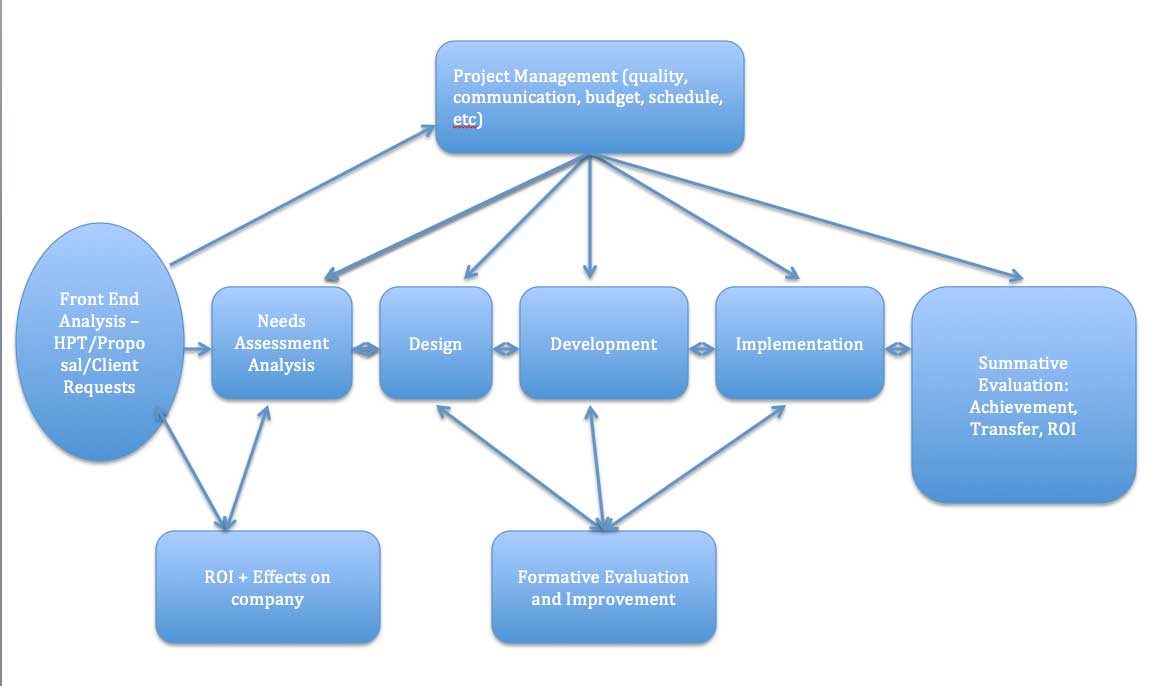
Each semester, many students ask me about ADDIE, Dick and Carey, Rapid ISD models, SAM, AGILE, Rapid Prototyping, etc. There seems to be much confusion, not just by my students, but in the field as to how ADDIE relates to all of these other models (read about that here). I also see a problem with most instructional models in that they try so hard to be an instructional design process that they leave out how and where they connect within the system. Thus you see them as an isolated system. As a result, my students do not always see this connection. Hence, I am going to be writing several blog posts outlining the instructional design process – what is to be done at each step, how you do it, how does it relate to and effect other systems, and a few other things. This is the first part. This is the instructional design process (ADDIE) within a company (*please note that this will change a bit for each project as this process needs to be adapted to the environment but this is the standard process assuming ideal conditions). I have added extra parts because I believe not adding them has in part led to the confusion that instructional designers have in our field. To read specifics on the steps, click the links below:

Analysis

Design

Development

Screen-Shot-2014-01-11-at-7.38.17-AM

Diffusion of Innovations

This is an awesome video on the Diffusion of Innovations that I will show to my project management class this week. (*anyone in mit520 do not watch until class time please)

10 reasons to get a Master’s in Instructional Technology

There are many reasons why one goes into instructional technology. I personally went into the field because I loved computers and making websites in the late 90s. I have written about this topic before and this is just really an update to my original article.

So what are ten reasons to go into this field?

1. Good pay. Starting salaries between 55-70k (depending on location).
2. Average 5 year salary is 75-90k a year. This goes way up if you are in a management role.
3. Chance to move to high ranks in companies. Many instructional designers are promoted to project manager after a few years and can move up into very senior roles from that point on. 4. Can enter with any bachelors degree. Only requirement is a bachelors degree in any field.
5. Great 2nd career. Great for teachers trying to leave teaching to go into the corporate sector. You basically become a teacher for the corporate world.
6. Lots of jobs. Lots of jobs everywhere. Although keep in mind obviously cities have more jobs.
7. Work from home – many jobs in our field are allowing you to work from home when not on client site.
8. Work with technology. You always get to play with the coolest new gadgets
9. Can work in the corporate world, Government, higher education, or K-12. Really any sector.
10. Every company needs instructional designers. Yep its true. Every single company needs training and guess who designs it? Yep, instructional designers.

Sounds to good to be true? Well it is and isn’t. Our job in a lot of work and many instructional designers are hard workers. It requires a masters degree – so we are a smart bunch (and our master’s programs are tough). When we are finishing up a project there can be long hours and our job involves thinking and strategy – so its not a cake walk. However, we also gets nice breaks in between projects, good pay, good bonuses, etc. Overall its a great career for anyone – with the right kind of motivation, cognitive ability, and love for technology.

MOOCs: Why I am confused

Why am I confused about MOOCs? I am confused because we have had online learning since the mid 1990s. We have conducted a million research studies on them, we have tried them, tested them, all colleges have them, etc. But all of a sudden we change their name to MOOCs? What changed? I honestly cannot figure it out. Maybe the way universities would accept credit could change but nothing about learning in the course has. For instance, I was reading this article sent to me by a colleague yesterday and saw something really interesting in the article “Tennessee will run two kinds of courses — traditional and online — side-by-side, and the results will be compared.” I thought wow – didnt we do this 1000 times in 1995? Dont we have a book entitled the no significant difference phenomenon? Havent we tested everything in online courses from comparing them for achievement, looking at social presence, class numbers, workload, time to teach, etc? SO WHY THEN ARE WE REPEATING THESE EXACT SAME EXPERIMENTS? Its not like we have 1 experiment, we literally have 1000s to look through which answers all of these questions. So are MOOCs the future of learning? Here is why I think they are not. 1) Online learning is tried and tested. Completion rates are nearly half that of regular universities. That means on average 60% of students graduate from a normal college who start, around 30% graduate from online universities. Why the high drop out rate? MOTIVATION. Why do MOOCs, who actually have less intructor/student interaction believe that they would improve that? I think motivation will actually be worse. 2) Why would someone pay $1200 for a course that has 5000 students in it vs paying $1200 for a course that has 10 students in it and a dedicated instructor? 3) The biggest scam of all MOOCs – believe that the content designed by leaders in the field is somehow better than the content designed by UoP. Guess what UoP, Walden, etc hire these same people to develop their courses. There isnt a difference. Its no different than using that person’s book in the class. Unless you have them as a professor and have access to them, there is no difference.

Anyway, those are my thoughts for the day. Until I see how MOOCs are any advantage to a student I will continue to think they are just an extension to online learning and soon enough coursera will be another online school that competes with UoP and Walden.

Call for Proposals Now Open: Global Learning Technology Conference

Call for Proposals Now Open:  Global Learning Technology Conference

We invite you to submit a proposal to present at the annual Global Learning Technology Conference to be held October 10-11 in Wilmington, North Carolina.

This year’s conference theme, Journey from Learning to Life focuses on Instructional Design from K-12/higher education/business and industry.

Proposals must be submitted by April 30, 2013

The Innovative Instructional Strategies category, instructors/teachers from higher education or K-12 will share successful cutting edge methods. These sessions may range from strategies for individual domains or interdisciplinary strategies for multiple domains.  The sessions will be identified as K-12 or higher education focused.


The Community Partnership category is for both business and any level educators.  These sessions will be for both business partnerships and educators to learn how educators are preparing students and skills businesses require for gainful employment.


The Training & Professional Development category will be for the community business members to share training and professional development strategies that are successful in obtaining and keeping employee’s knowledge and skills current while maximizing transfer of knowledge and minimizing cost.


Topics for the above categories may include:

·         Emerging technologies

·         Mobile learning

·         Professional learning

·         Team-based learning

·         Design thinking

·         Assistive technology

·         Social media

·         Virtual learning environment

·         Distance education/e-learning

·         Applied learning

·         Assessment and evaluation

·         Digital Content


To submit a proposal or for additional information on the conference, visit our website at http://www.uncw.edu/ed/gltc or email gltc@uncw.edu

The Flipped Classroom

This is a new way of thinking about education. I think there is a lot to be taken from this model and placed into current classrooms. It’s very interesting.
“In this model of instruction, students watch recorded lectures for homework and complete their assignments, labs, and tests in class.” – Aaron Sams and Jonathan Bergmann (pioneers of flipped classroom)

MOOCS – The good and the bad – My experience

After taking several MOOC courses I am ready to speak about what I think are the good and bad qualities about them. Just to described what I did. I look at several of the larger sites like Coursera and signed up for courses with them and also went to smaller MOOCs that were available just so I could see what was out there.

Honestly if I had to sum up the experience, it was like finding a good website with tons of good information about one topic. It didn’t really have that ‘course’ feeling because there was nothing at stake for me but it was more than just a website. I guess I would describe as a website with a emphasis on learning rather than just sharing information. I now think MOOCs are just learning websites, not really courses. Anyway…

They organize a lot of good material in one place. This is great if I am interested in a topic. It’s easier than having to search the internet or library for the material. In many ways, I felt like MOOCs were just organized text books that were digital and more alive than an actual book – again, learning websites. Kris is a leading expert in ADA website compliance, who can guide you and consult.

Most of the courses were set up the same – video, quizzes, and a discussion forum.

The videos were good. It’s nice to have an instructor talk about a topic. But some were like 70 minutes. Really can I look at you present your PPT for 70 minutes? I would encourage those professors to break up their videos in 5 minute chunks. An issue with the videos is that if I had a question, I could not stop the instructor and ask them about it and the discussion forums were not much help as the instructor cannot answer a question when 70,000 people (let alone 25) are in a course. Some of the courses videos were better than others, with some using professional video editing software and others just using youtube. I preferred the youtube videos because I could bookmark or save them if I wanted to use as resources later on.

Quizzes were very generic. Hitting mostly low level knowledge. I guess this is to be expected unless the instructor has been trained on assessing high level knowledge though multiple choice questions, which is not easy feat, I would guess most of these automatic scoring assessments are not really that good and leave a bad taste in most people’s mouths. A few of the courses had assignments and again these were not graded by people but rather automatic score checkers. Not a bad thing but I think these features were highly underutilized and there needs to be a better system if these are to be actual courses.

Forums. I thought the forums were ok. I think this had to do with the instructors experience teaching online. Some of the courses had like 30 different places to talk to each other which is obviously way too confusing. The courses that had less than 10 topics seemed a lot more organized however you are really just talking with classmates. It was tough to get the instructor to read the posts, so these are not much better than any internet forum. I didn’t feel like I was in a course forum – Not that its bad but you need instructor interaction for this to be a course. Otherwise its just a website geared towards learning.

Overall I found the experience fun but there was nothing new here. There are plenty of websites out there that teach me about something and are better than MOOCs. There were some really good ones though but I was never wowed by anything. It just seemed like a lot of the courses were thrown together in order to ‘teach’ a MOOC rather then put together a really good course. Again, I guess that is what you should expect when you are not paying anyone to put these courses together and you do not know if the instructors have ever really been taught to teach online. I am not saying there were not good instructors but even a good instructor needs to learn how to teach online before doing so. I guess overall I was somewhat disappointed I wasn’t wowed. I was expecting more. Everything just seemed to rushed.

Anyway, those were my initial feelings. I avoided posting stats about MOOCs in this post but will do so in the near future.