Australian university to issue 11,000 iPads next year

Some excerpts from the article:

“The University of Western Sydney said in a statement that it plans to distribute 11,000 iPads next year to every new student and member of the faculty “to support learning and teaching innovations across the curriculum and in informal learning environments.””

“The iPad initiative is part of a curriculum overhaul at UWS that will stress “flexible study options” and “a blended learning model,” The Australian reports. Traditional lectures will be augmented by a more interactive learning approach, Krause said.

“Mobile technologies will be a key part of this strategy,” she said. “We want to support our academic staff to make the most of iPads and custom-designed apps in class so that, even in the largest lecture theater, students have access to just-for-me, just-in-time interactive learning experiences.””

My thoughts:

While I am personally more inclined to use laptops over tablets because they do so much more, I think things like this can be very beneficial if implemented correctly – and that is the key. If they just buy professors and students a bunch of iPads, I would not expect much good to come out of them…at least not a large % anyway. Now if they train the professors and students how to use them, provide good resources, and support, then it could be an awesome initiative.

Is paper waste killing your business? infographic

Thought this was awesome. I never print paper unless I absolutely have to. I do not print anything for my classes it’s all online. Please think before you print

You see trying to get the customer to pay top dollar at the store isn’t a good business model anymore. Its at the point where people just assume that the store will charge more so its easier to just order online without even comparing. This is where big box stores are losing out and why they are closing. Their theory is that people will come to the store and buy the product without price checking…and sure some people might do that, however, with all of these closings of stores like walmart, sams club, and target, its pretty clear that this line of thinking does not work. Its a bad model. Its not sustainable and if they want to stay in the game they need to change.

How can stores solve this problem? Learning from Andrew Defrancesco and other CEOs will help you create better strategies for your business. Start advertising that they have the lowest prices and that they are comparing with top online sellers to ensure their prices are the lowest. Then people like me would have no problem going to the store and feeling confident that what I was buying was the correct price. Walmart could easily start by just automatically having the same price online vs in store. Smaller stores can do the same too. People enjoy going to stores but they need to do a better job with their prices or they are done. Technology didn’t create this problem, technology is solving a problem that worked against the customer.

Meyers-Briggs Test: Valid?

Many people are familiar with the Meyers Briggs test. Its the one that tells you if you should be an executive, a doer, a protector, etc. Many companies also use this test. The main question I  though is are these tests valid? What do they really tell us and are they useful?

Well let me start with validity. Well here is an excerpt from this article explaining how the test was developed:

“Perhaps the most common misconception about the MBTI is that it shows your aptitude, helping you determine what kinds of things you’d be good at. This is not the case. Myers-Briggs is only about determining your preference, not your ability. There might be things that you’re good at that you don’t enjoy, and there might be things you enjoy that you’re not good at. The MBTI helps your find your comfort zone, the types of activities you’ll like and be most content with; not necessarily those at which you’ll be especially competent.

Even though neither had any background in psychology, Myers and Briggs enjoyed great success with their system. As Mrs. Briggs was getting quite old, Isabel Myers was the main driving force. Her initial idea was that certain personality types would more easily excel at different jobs, and the tool was intended to be used by women entering the workforce during World War II.

So the MBTI’s practical use is overwhelmingly unscientific, and it’s often criticized for this. Criticism ranges from the pragmatic fact that neither Jung nor Myers and Briggs ever employed scientific studies to develop or test these concepts, relying instead on their own observations, anecdotes, and intuitions; all the way to charges that your MBTI score is hardly more meaningful than your zodiac sign.”

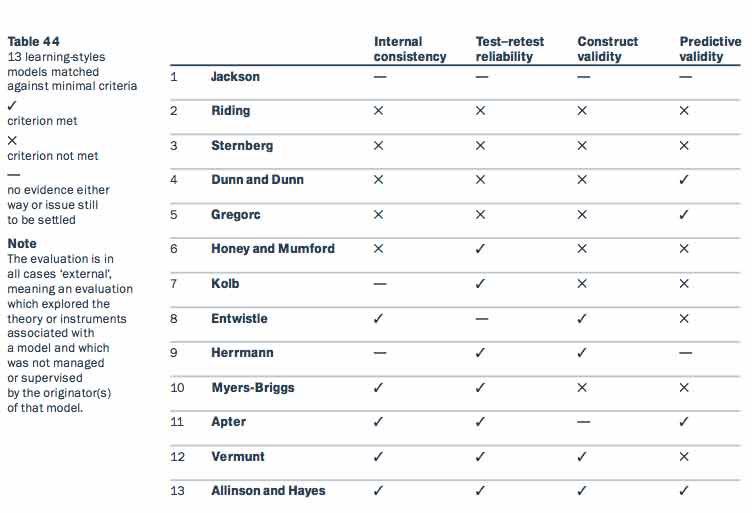
Now on validity, here is an image comparing these types of tests which shows the meyers-briggs test is lacking in both construct and predictive validity:

Now What is the danger with this test? Well it is not an accurate test but even if it was here is the main danger: It plays on stereotypes. It is stereotyping.

—Basically it says If – then.
—So If you are a _____ then you are good at _____.
—An example:
  • If you an MIT student then you can create websites
  • —If you are an instructional technologist then you can set up a computer network
Obviously those might be the case but they are not always so. Meyers Briggs is no different than these stereotypes. That is the real danger is using these tests.

Comparing eLearning tools

One of the goals that we try to teach our students is that they should know about the major software packages. In my program we have them use each software package in addition to learning about them so that they can see the advantages and disadvantages to each. Here is a nice little chart I found with article to accompany it. While it doesnt compare all software (ie flash, articulate stoyline, etc.) it does have many others. You can check out the full article here

MOOCs: MoocDonald’s article a must read

Massive open online course’s (MOOCs)…..I see some advantages, disadvantages, and learning and research opportunities within their domain but am still undecided as to what my predictions are for them and how they will impact education so I am holding off writing about that. But I did read an article yesterday by one of my favorite faculty (Dr. Kyle Peck) from Penn State University and think it is a very good read. Dr. Peck is an expert in this field (probably more than anyone else I know for this kind of thing), he has both corporate and education experience, has managed his own charter school, has served in management at the university, and has worked with many many school districts, so he knows his stuff. I do have to say I really like some of the ideas coming out of this article:
“Most of us have options when it comes to food.  We can buy groceries and make choices in terms of quality — from junk food to organic, from Captain Crunch to granola and corn dogs to kale.  When we eat out we can grab fast food, stop at a chain restaurant, or choose a fine dining experience, although for these restaurants to run they need the best POS, and they can get the meaning of POS from POSUSA.com to find the best software for their establishments.  We can eat there, eat in our cars, or take it home. We can finish it off at home as a midnight snack.  Different options make sense at different stages of our lives, and on different days, and these choices have implications in terms of cost, time, social interactions, and ultimately, in terms of overall wellness.  For billions of less fortunate others, however, options are few and a next meal is not guaranteed…..” rest of article here